What Is the Difference Between MIG and TIG Welding?
MIG vs. TIG Welding: Core Differences Explained
Think of welding as drawing with metal. MIG welding is like using a thick marker—it’s fast, gets the job done efficiently, and is perfect for bigger projects. TIG welding is like using a fine-point pen—it requires a steady hand for precise, detailed work. Both join metal, but the tools, techniques, and results are worlds apart. Choosing the right one saves you time, money, and a lot of frustration.
How the Equipment Actually Works
The most fundamental difference lies in the welding gun and the shielding gas. Each process uses a different setup to create the arc that melts the metal. For a deeper look at how the arc works, explore our guide to arc welding.
The MIG Welding Setup (GMAW)
In MIG (Metal Inert Gas) welding, a continuously fed solid wire electrode travels through the welding gun. When you pull the trigger, the wire feeds, electricity flows, and shielding gas (like argon or a mix) flows from the nozzle to protect the weld puddle from air. It’s an all-in-one system that’s semi-automatic. The machine controls the wire feed speed, making it very user-friendly once set up.
The TIG Welding Setup (GTAW)
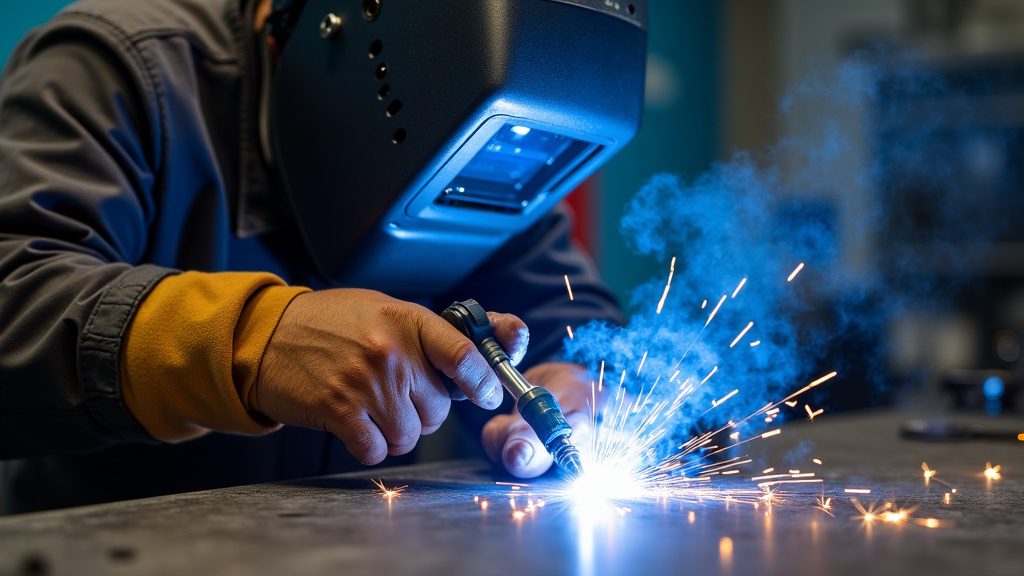
TIG (Tungsten Inert Gas) welding is a two-handed process. You hold a non-consumable tungsten electrode in one hand to create the arc and heat. With your other hand, you manually feed a separate filler rod into the molten puddle. Shielding gas, typically pure argon, is always flowing to protect the weld. This method gives you complete control over the heat and the amount of filler material added.
A Quick Comparison at a Glance
Here’s a simple table to visualize the key differences before we dive deeper into each one.
| Feature | MIG Welding (GMAW) | TIG Welding (GTAW) |
|---|---|---|
| Electrode | Consumable wire | Non-consumable tungsten |
| Filler Metal | Fed automatically via wire | Fed manually with a separate rod |
| Shielding Gas | Argon, CO2, or mixes | Usually pure Argon |
| Process | Semi-automatic, one-handed | Manual, two-handed |
| Foot Pedal | Rarely used | Almost always used for heat control |
| Learning Curve | Moderate – easier to start | Steep – requires significant practice |
| Typical Speed | Fast deposition rates | Slow and deliberate |
Which One Is Easier to Learn and Use?
If you’re brand new to welding, MIG is the clear starting point. Most people can lay a decent-looking bead within an hour or two of practice. The machine does a lot of the work for you, feeding the wire at a constant speed. It’s forgiving of imperfect body positioning and is the go-to method for quick repairs, automotive work, and general fabrication.
TIG, on the other hand, is the advanced course. It demands coordination between your hands, feet (for the pedal), and eyes. You control the heat with a foot pedal while simultaneously feeding filler rod at the right speed and angle. Many experts say it takes weeks or months of dedicated practice to produce consistent, high-quality welds. The American Welding Society often notes that TIG certification is a benchmark of a welder’s skill (AWS).
Weld Appearance and Quality
What the finished weld looks like is a huge differentiator, and it often dictates which process is used.
The Look of a MIG Weld
A MIG weld typically has a wider, slightly convex bead. It can have a “stacked dimes” appearance if done well, but it can also be a bit messier. There might be minor spatter—tiny metal balls—around the weld zone. While it’s strong and perfectly fine for many structural and repair jobs, its visual appeal is generally functional rather than artistic.
The Beauty of a TIG Weld
TIG is the artist’s tool. The process allows for exceptionally clean, flat, and precise welds with minimal spatter. Because you have total control, you can create perfectly uniform beads that look like they were laid by a machine. For visible welds on projects like custom motorcycle frames, furniture, or food-grade stainless steel pipes, TIG is the professional choice. The quality and aesthetics often speak for themselves.
What About the Speed and Cost?
For any project, time and money are always factors. Here, the two processes trade blows.
MIG is Built for Speed
MIG welding is significantly faster for depositing metal. The continuous wire feed and higher amperage mean you can fill joints and join thick materials quickly. This efficiency makes it the standard in production shops, manufacturing, and automotive repair where output speed matters.
TIG Requires Patience and Precision
TIG is a slow, deliberate process. Every movement is intentional, and the heat must be carefully managed. While this means it takes longer, it also means there is less cleanup afterward. The lack of spatter and fumes can save time on grinding and post-weld finishing. The initial equipment cost for a quality TIG machine is also often higher than for a comparable MIG welder.
Best Materials for Each Welding Type
The type of metal you’re working with is often the biggest deciding factor in which welding method to use.
Where MIG Excels
- Mild Steel: This is MIG’s home turf. It’s fast, effective, and economical for steel fabrication, structural work, and car repairs.
- Thicker Metals: MIG can handle thicker sections of metal more easily due to its higher deposition rate.
- Stainless Steel & Aluminum: With the right gas and wire, MIG can be used on these metals, though TIG often provides superior results for critical applications.
Where TIG is Superior
- Aluminum: TIG provides far greater control over the heat-sensitive aluminum, resulting in cleaner, stronger welds without burn-through.
- Thin Materials: From sheet metal to food-grade tubing, TIG’s low heat input and precision prevent warping and damage to delicate pieces.
- Exotic Metals: For metals like titanium, magnesium, and copper alloys, TIG is often the only reliable method that ensures weld integrity and purity.
- Critical Joints: In aerospace, nuclear, and medical equipment, TIG is specified for its superior quality and consistency.
Real-World Applications: Which Job Needs Which?
Let’s look at where you’d typically find each process in action.
Everyday Jobs for MIG Welding
MIG is the workhorse. It’s used in auto body shops for panel repair, in manufacturing for assembling steel structures, by farmers for fixing equipment, and by hobbyists in their garages for building things like gates, trailers, and furniture. Its speed and ease make it ideal for production and repair.
Specialized Jobs for TIG Welding
You’ll find TIG where quality and appearance are paramount. This includes custom motorcycle and car fabrication, building stainless steel food processing equipment, creating architectural metal art, and repairing high-performance components in the aerospace industry. Anywhere you see a beautiful, rainbow-colored weld on stainless steel, it’s almost certainly TIG.
Choosing the Right Welder for Your Needs
Still not sure? Use this simple checklist to guide your decision.
- Are you a beginner looking to learn quickly? Start with MIG.
- Is your primary goal speed and efficiency on thicker steel? Choose MIG.
- Do you need to weld thin sheet metal or aluminum with precision? Learn TIG.
- Is the visual appearance of the weld critical to your project? Go with TIG.
- Are you on a tight budget for equipment? A basic MIG setup is more affordable.
- Do you have the patience and time to practice extensively? Investing in TIG skills is rewarding.
The Safety Considerations You Can’t Ignore
Both processes require proper safety gear, but the risks have slight nuances. We found that while both generate dangerous UV radiation and spatter, the concerns differ. MIG welding produces more spatter and potentially more fumes, especially on galvanized or coated metals, making ventilation critical (CDC). TIG, while producing less spatter, uses an even more intense UV arc, making high-quality auto-darkening helmets essential to prevent eye damage. Always, without exception, use a proper welding helmet, gloves, fire-resistant clothing, and work in a well-ventilated area.
Conclusion
Choosing between MIG and TIG comes down to your project’s needs and your experience level. **MIG welding is your efficient workhorse**, perfect for beginners, speed, and everyday repairs on thicker steel. **TIG welding is your precision artist**, requiring patience but delivering unmatched control, beauty, and quality for thin metals, aluminum, and critical work. You now have a clear framework to decide: think about your material, desired finish, and how much time you have to practice. Your next step is to honestly assess your current project, then select the method that matches those real-world demands.
Frequently Asked Questions
Can you use the same machine for both MIG and TIG welding?
Many modern welding machines are “multi-process” and can be set up for both MIG and TIG. However, you will still need different accessories, like a TIG torch and a foot pedal, which are often sold separately. Always check the specific machine’s capabilities before purchasing.
Which process is safer for a beginner to learn first?
From a technique standpoint, MIG is generally safer for beginners. It’s easier to control, produces a more contained arc, and requires less complex body positioning. Both processes demand proper safety gear, but MIG’s simpler operation can reduce initial mistakes.
Why is TIG welding so much slower than MIG?
TIG’s slower speed is a direct result of its manual control. You are simultaneously managing the arc with a foot pedal, precisely feeding filler rod by hand, and guiding the torch. This deliberate pace is what allows for such clean, precise welds without excess heat or spatter.
Is TIG welding always better than MIG?
No, TIG is not universally better. It is better for specific applications requiring high precision, aesthetics, or work on sensitive materials like thin aluminum. For many structural, automotive, or fabrication tasks, MIG’s speed and simplicity make it the more practical and cost-effective choice.
What’s the main reason a professional welder needs to know both?
A professional welder needs both skills to handle diverse job requirements. A client may need a quick, sturdy repair on a tractor (MIG) and a beautiful, custom stainless steel railing (TIG) in the same week. Versatility makes a welder more valuable and capable of taking on a wider range of projects.