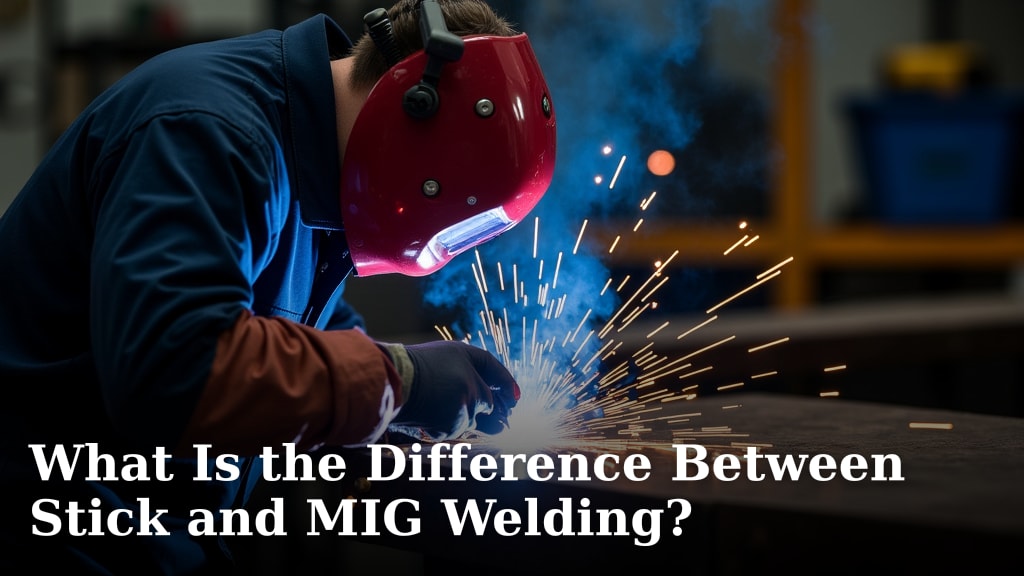
What Is the Difference Between Stick and MIG Welding?
The main difference between stick welding and MIG welding comes down to how the welding rod and filler metal are fed. Stick welding uses a consumable electrode rod coated in flux. MIG welding uses a continuous wire feed that also acts as filler metal. You’ll often hear MIG welding called Gas Metal Arc Welding, or GMAW.
Choosing between stick and MIG welding depends on your project and skill level. Stick welding is generally better for outdoor work and rougher metals, as it’s less sensitive to wind and dirt. MIG welding offers cleaner welds and is often easier for beginners to learn on clean, thin materials. Both methods produce strong, reliable joints when done correctly.
- Stick welding uses a flux-coated rod for welding.
- MIG welding uses a continuous wire feed.
- Stick is better for outdoors and rougher jobs.
- MIG is easier for beginners on clean, thin metal.
- Both methods create strong welds.
Now, let’s break down what makes each welding process unique and help you decide which one might be best for your needs.
Comparing Stick and MIG Welding: Which Process Suits You?
The core difference between stick and MIG welding lies in the delivery of the filler metal. Stick welding uses a flux-coated rod that burns away. MIG welding uses a continuous wire that melts and becomes the filler. Understanding these basic mechanics will help you choose the right tool for your job.
Understanding Stick Welding (SMAW)
Stick welding, also known as Shielded Metal Arc Welding (SMAW), is one of the oldest and most versatile welding methods. It’s a tried-and-true process that many experienced welders rely on.
How Stick Welding Works
You use a welding gun that holds a consumable electrode rod. This rod is covered in a flux coating. When you strike an arc between the rod and the metal you’re joining, the rod melts. The heat from the arc also melts the base metal. The molten metal from the rod mixes with the molten base metal to form a weld pool. The flux coating burns and creates a shielding gas. This gas protects the weld pool from atmospheric contamination. It also forms a slag layer over the cooling weld. You have to chip this slag off later.
The Role of the Flux Coating
That flux coating is super important. It’s not just there for show. The flux provides shielding gas to prevent oxygen and nitrogen from weakening the weld. It also contains deoxidizers to clean the molten metal. Plus, it adds alloying elements to improve the weld’s strength and appearance. Some flux coatings also help to stabilize the arc, making it easier to control.
When Stick Welding Shines
Stick welding is a fantastic choice for outdoor projects. Why? Because the thick flux coating provides excellent shielding, even in windy conditions. Many experts find it’s also very effective for welding dirty or rusty metal. You often don’t need to clean the metal as thoroughly as you would for MIG welding. This makes it a go-to for construction sites, repair work, and general fabrication where portability and toughness are key.
Advantages of Stick Welding
- Works well outdoors: Wind doesn’t easily blow away the shielding provided by the flux.
- Handles rough surfaces: Less sensitive to dirt, rust, and paint on the base metal.
- Cost-effective: The equipment can be less expensive to purchase.
- Versatile: Can weld a wide range of metals, including steel, stainless steel, and cast iron.
Challenges with Stick Welding
Stick welding does come with a learning curve. You need to carefully control the angle and distance of the electrode. It also produces more spatter and smoke than MIG welding. And, as mentioned, you’ll have slag to clean off the finished weld. This means more post-weld cleanup time. Plus, it can be harder to achieve a visually clean and smooth weld bead compared to MIG.
Exploring MIG Welding (GMAW)
MIG welding, or Gas Metal Arc Welding (GMAW), is a popular choice, especially for beginners. It’s known for its speed and ease of use on many common materials.
How MIG Welding Works
With MIG welding, you use a gun that feeds a continuous wire electrode. This wire acts as both the electrode and the filler metal. As you pull the trigger, the wire feeds out, and an arc forms between the wire and your workpiece. Simultaneously, a shielding gas (usually a mix of argon and CO2) flows from the gun’s nozzle. This gas creates a protective bubble around the arc and weld pool, preventing contamination. The wire melts, adding filler metal to the joint.
The Role of the Shielding Gas
The shielding gas is critical in MIG welding. It replaces the flux coating found on stick electrodes. The right gas mixture is essential for a good weld. Common mixtures like 75% Argon and 25% CO2 are good for steel. They help create a stable arc and good penetration. For different metals like aluminum, you might use pure Argon.
When MIG Welding Excels
MIG welding is fantastic for working with thin metals and achieving cleaner welds. Because the wire feed is consistent and the shielding gas is precise, it’s often easier for beginners to learn. You can get great-looking results fairly quickly. Many people find it ideal for automotive repair, home projects, and fabrication shops where consistency and appearance matter.
Advantages of MIG Welding
- Easier to learn: Many find the trigger-and-go nature simpler than managing a stick electrode.
- Cleaner welds: Produces less spatter and no slag, leading to less cleanup.
- Faster welding speed: The continuous wire feed allows for quicker deposition of metal.
- Good for thin materials: Offers better control on thinner gauge metals.
Challenges with MIG Welding
MIG welding isn’t as well-suited for windy conditions. The shielding gas can be blown away, leading to weak or contaminated welds. You also need to ensure your base metal is quite clean. Rust, paint, or oil can cause porosity and weld defects. You’ll need access to a power source and a cylinder of shielding gas, which makes the setup less portable than stick welding.
Key Differences at a Glance
Let’s sum up the main distinctions you’ll encounter:
| Feature | Stick Welding (SMAW) | MIG Welding (GMAW) |
|---|---|---|
| Electrode/Filler | Flux-coated consumable rod | Continuous wire feed |
| Shielding | Flux coating creates gas and slag | External shielding gas |
| Portability | High (no gas bottle needed) | Lower (requires gas bottle) |
| Outdoor Use | Excellent | Poor (wind sensitive) |
| Metal Thickness | Good for thicker metals | Excellent for thin metals |
| Cleanup | Requires slag removal | Minimal cleanup (less spatter) |
| Skill Level | Steeper learning curve | Easier for beginners |
Making Your Choice: What to Consider
Deciding between stick and MIG welding often comes down to a few practical questions about your intended use.
Your Project Needs
Are you working on a fence post outdoors where wind is a factor? Stick welding might be your best bet. Are you repairing a car’s body panels or building something from sheet metal indoors? MIG welding often provides a cleaner, more precise result. Many sources suggest considering the material thickness you’ll be working with most often (American Welding Society).
Your Skill Level and Patience
If you’re just starting out and want to see results quickly on clean projects, MIG is generally more forgiving. If you’re willing to put in the practice to master a more versatile tool, stick welding can be incredibly rewarding. Research indicates that the constant wire feed of MIG helps beginners achieve a more consistent bead from the start.
Your Workspace
Do you need to move around a lot? Stick welders are usually more portable. Do you have a dedicated space with access to power and gas? MIG welding might be more convenient. It’s also worth noting the ventilation. Stick welding produces more smoke and fumes, so good ventilation is a must.
Budget Considerations
While initial equipment costs can vary, entry-level stick welders are often cheaper than comparable MIG setups. However, factor in the ongoing cost of consumables like welding rods for stick and wire and gas for MIG.
Here’s a quick checklist to help you think it through:
- Will you weld mostly outdoors?
- Are you working with thin materials often?
- Do you prioritize ease of learning?
- Is portability a major concern?
- Do you prefer less post-weld cleanup?
Answering these will steer you toward the right welding process for your toolbox.
Conclusion
Choosing between stick and MIG welding comes down to your specific needs. Stick welding offers rugged performance outdoors and on less-than-perfect surfaces, making it a reliable workhorse. MIG welding, on the other hand, excels in speed and producing clean, precise welds, especially on thinner materials and indoors. You’ve learned how each process works, their strengths, and their challenges. Consider your typical projects, workspace, and how much practice you want to put in. For your next project, think about which of these characteristics best matches your goals to make the right choice.
Frequently Asked Questions
Which welding method is better for a beginner?
Most sources agree that MIG welding is generally easier for beginners to pick up. The continuous wire feed and simpler control of the welding gun allow new welders to focus on maintaining a consistent arc and travel speed. Stick welding requires more coordination to manage the electrode angle and arc length.
Can I weld outside with MIG?
It’s not ideal to use MIG welding outdoors, especially in windy conditions. The shielding gas that protects your weld can easily be blown away by the wind. This can lead to weak, porous welds that are not structurally sound. Stick welding is a much better option for outdoor projects because its flux coating provides more robust shielding.
Which type of welding is faster?
MIG welding is typically faster than stick welding. The continuous wire feed means you don’t have to stop to replace electrodes as often. This allows for a more consistent and uninterrupted welding process, which speeds up overall project completion times for many applications.
Do I need to clean my metal thoroughly for both welding types?
You need to clean your metal well for both processes, but stick welding is more forgiving of surface contaminants like rust or paint. MIG welding requires cleaner surfaces to prevent porosity and ensure a strong bond. You’ll often find that less preparation is needed before using a stick welder on rougher materials.
Which welding process creates a stronger weld?
Both stick and MIG welding can create very strong welds when performed correctly. The strength of the weld depends more on proper technique, understanding the materials, and using the right settings than on the process itself. Research indicates that for critical structural applications, both methods are widely used and respected.