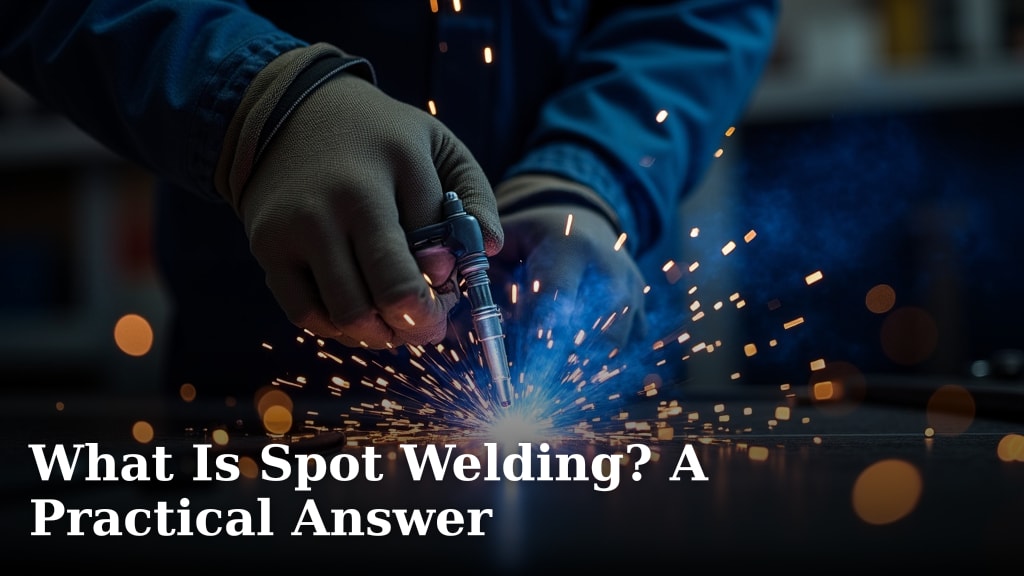
What Is Spot Welding? A Practical Answer
Spot welding is a process that joins two metal sheets together by applying heat and pressure at a single point. It uses an electrical current to melt a tiny area where the metal overlaps, creating a strong, permanent bond. You’ll often see it in manufacturing because it’s fast and efficient.
This method is a staple in industries like automotive and appliance production. We found it’s valued for creating strong, reliable joints without needing extra materials like solder or bolts. Many experts say its simplicity and speed are key reasons for its widespread use.
- Spot welding is a method for joining metal using heat and pressure at a single point.
- The process uses an electrical current to melt a small spot, fusing the metal sheets.
- It is widely used in manufacturing cars, appliances, and electronics for its speed.
- The main advantages are its strength, efficiency, and low cost for high-volume work.
- Key factors for success include proper pressure, current, and clean metal surfaces.
Below, we’ll walk you through exactly how this powerful technique works step by step.
How Spot Welding Works: A Step-by-Step Guide
Think of spot welding like a quick, powerful handshake between two pieces of metal. You use **heat** and **pressure** at one specific spot to fuse them together. It’s a surprisingly straightforward process, but it relies on a few key elements working in harmony.
The goal is simple: to melt a tiny area where the metals overlap, then let it cool into a solid bond. We found this method is valued because it creates a strong joint without adding extra materials like glue or screws. It’s all about precision and control.
The Core Principle Behind Spot Welding
At its heart, spot welding is a form of resistance welding. You pass a high **electrical current** through the metal sheets. The metal has natural resistance, and that resistance generates **intense heat**. This heat melts the metal at the contact point.
You then apply firm **pressure** to push the molten metal together. When it cools, it forms a solid, permanent bond. Many experts describe it as a localized, controlled melt. It’s not like welding the entire seam; it’s just one strong point.
The Key Components of a Spot Welding Setup
To do this job, you need a few essential parts. Think of them as the essential tools in your toolbox. Each one plays a critical role in making a good weld.
- Copper Electrodes: These are the “arms” that deliver the current and pressure. Copper is used because it conducts electricity well and doesn’t stick to the metal.
- Transformer: This device steps up the voltage to create the needed electrical current.
- Timer: This controls how long the current flows. Too short, and the weld is weak. Too long, and you might burn through the metal.
- Pressure Mechanism: This ensures the metal sheets are held together tightly before and during the weld.
We found that keeping the electrodes clean and properly aligned is crucial for consistent results (AWS). Even a little dirt can throw off the entire process.
Step-by-Step: What Happens During a Spot Weld
Let’s break down the actual welding sequence. It happens very quickly, often in less than a second.
Step 1: Preparation and Alignment
First, you clean the metal surfaces. Any oil, rust, or paint can interfere with the weld. Then, you align the two metal sheets where you want the bond. They overlap slightly. This is the **faying surface**.
You position them between the copper electrodes. You need to ensure the overlap is correct. A gap or misalignment leads to a weak spot. It’s like setting up a perfect sandwich before you press it down.
Step 2: Applying Pressure
Next, the machine applies strong **mechanical pressure**. The electrodes squeeze the metal sheets together. This pressure does two things. It ensures good electrical contact. It also holds everything in place.
The pressure must be consistent. If it’s too light, the metal won’t make good contact. If it’s too heavy, it can deform the sheets. Many guidelines point to pressure as a key factor for a strong weld (AWS).
Step 3: The Electrical Current (The “Spot”)
Now, the machine sends a **short burst of high current** through the electrodes. The current flows from one electrode, through the top sheet, to the bottom sheet, and back up. The resistance at the overlap creates intense heat.
This heat melts a small, nugget-shaped area of metal. You can’t see this happening, but it’s the critical moment. The metal turns molten in a fraction of a second. It’s a controlled burn, not a free-for-all.
Step 4: Cooling and Solidification
The current stops, but the pressure remains for a brief moment. This is the “hold” time. The molten metal cools rapidly and solidifies under pressure. The bond becomes strong and permanent.
Finally, the electrodes release, and the newly welded part moves on. The entire cycle is fast and repeatable. This is why spot welding is so popular in factories with assembly lines.
Where Is Spot Welding Used? Common Applications
You’ll find spot welding in many places you might not even notice. It’s a workhorse of manufacturing. Its speed and strength make it ideal for high-volume production.
Automotive and Heavy Manufacturing
This is the biggest area for spot welding. Car bodies are a prime example. A single car frame can have hundreds of spot welds. They hold the body panels together securely.
Research shows that spot welding is the standard for joining steel sheets in automotive assembly (SAE International). It’s faster and cheaper than other methods for this type of work. You can weld an entire car body in minutes.
Appliances and Electronics
Think about your refrigerator, washing machine, or microwave. The metal casings and internal frames are often spot welded. It creates a clean, strong joint without visible fasteners.
In electronics, it’s used for battery packs and small metal components. The process is precise and can join very thin sheets. It’s about making durable products without adding extra weight or complexity.
Advantages and Limitations of Spot Welding
Like any method, spot welding has its pros and cons. It’s not perfect for every job, but it excels where it’s needed. Here’s what we found.
Why Spot Welding Stands Out
- Speed: A single weld takes less than a second. This is perfect for assembly lines.
- Strength: The weld nugget creates a very strong joint, often stronger than the base metal itself.
- Low Cost: It requires no extra materials like bolts or adhesives. It’s very economical for high-volume work.
- Clean and Simple: There’s no need for filler materials or complex post-processing. It’s a clean, efficient process.
Many experts say its efficiency and reliability are why it’s used so widely in manufacturing (Automation World).
When Spot Welding Might Not Be the Best Choice
It’s not a one-size-fits-all solution. Here are some limitations.
- Material Limitations: It works best with similar metals of similar thickness, like steel or stainless steel. It’s less effective for very thick or dissimilar metals.
- Accessibility: You need access to both sides of the joint to place the electrodes. It won’t work if you can’t reach both sides.
- Joint Design: It’s mainly for lap joints where sheets overlap. It’s not for joining pipes or complex shapes.
So, while it’s great for sheet metal, it’s not the right tool for every project.
Spot Welding vs. Other Joining Methods
How does spot welding stack up against other ways to join metal? It’s helpful to see a side-by-side comparison. This table highlights the key differences. For example, our gas welding guide explains another common method for joining metals.
A Quick Comparison Table
| Method | How It Works | Best For | Key Advantage | Limitation |
|---|---|---|---|---|
| Spot Welding | Uses heat and pressure at a single point. | High-volume sheet metal assembly. | Extremely fast and low cost. | Limited to overlapping sheets. |
| MIG Welding | Uses a continuous wire electrode and gas shield. | Thicker materials and general repairs. | Versatile and strong for various metals. | Slower and requires more skill. |
| Adhesive Bonding | Uses a chemical glue or adhesive. | Non-metal materials or where no heat is needed. | Distributes stress evenly and is lightweight. | Not as strong for heavy loads. |
| Riveting | Uses metal pins (rivets) to clamp layers together. | Structural applications and dissimilar metals. | Very strong and visible for inspection. | Heavier and adds extra material. |
As you can see, spot welding wins when you need speed and efficiency with similar sheet metals. It’s a specialized tool that does its job exceptionally well.
Tips for Effective Spot Welding (Checklist)
Whether you’re observing or working with spot welding, these key points ensure a good result. Think of this as your quick reference guide. Remember, safety first in any industrial setting.
- Clean the Surfaces: Always remove oil, rust, paint, and dirt before welding. Contamination causes weak welds.
- Check Electrode Alignment: Make sure the
Conclusion
You now understand that spot welding is a fast, efficient method for joining metal sheets using heat and pressure at a single point. Its key strengths include creating strong, reliable bonds quickly and at a low cost, which is why it’s widely used in manufacturing cars and appliances. Remember, it works best for similar, thin metals where you can access both sides of the joint. If you’re considering this technique, start by assessing your materials and ensuring you have a clean, properly aligned setup. With attention to those details, spot welding can deliver durable results for your high-volume projects.
Frequently Asked Questions
What materials are best for spot welding?
Spot welding works best on similar, conductive metals like steel and stainless steel. It is less effective for very thick materials or dissimilar metals, such as aluminum to steel. Always ensure your metals are compatible for the strongest bond.
How many spot welds are typically needed for a strong joint?
The number of spot welds depends on the size and strength required for your project. For example, a car body might have hundreds of welds for structural integrity. We recommend following manufacturer guidelines or engineering standards for optimal spacing.
Can spot welding be used on painted or coated metal?
No, spot welding requires clean, bare metal surfaces for a proper electrical connection. Paint, oil, or rust can cause weak welds or electrode damage. Always clean the metal thoroughly before starting the welding process.
What is the typical lifespan of a spot weld?
A properly made spot weld can last as long as the base metal itself, often the entire life of the product. Factors like material quality and environmental exposure affect longevity. Regular inspections can help ensure ongoing reliability in critical applications.
Is spot welding more cost-effective than using bolts or rivets?
For high-volume production of sheet metal, spot welding is generally more cost-effective. It eliminates the need for extra materials like bolts and reduces assembly time. However, for small-scale or repair work, other methods might be more practical. Similarly, our arc welding guide covers yet another approach for repair work.