Transformer vs Inverter Welder: Which Should You Choose? (November 2026)
Choose an inverter welder for portability and adjustable control, or a transformer welder for simple workshop use and steady input power. Your outlet, welding process and duty needs should guide the choice.
On this page (10 sections)
- Transformer vs inverter welder: what is the main difference?
- Which welder is easier to control?
- Does a transformer or inverter welder need more power?
- Which is better for portability?
- Which model suits a small metal workshop?
- Where does a transformer plastic welder fit?
- How should you compare welding controls?
- What care does each welder need?
- Is an inverter welder better for outdoor work?
- What should you choose: welder transformer or inverter?
Choose an inverter welder for portability and adjustable control, or a transformer welder for a fixed workshop with dependable power. The right answer depends on your welding process, outlet, duty needs and how often you move the machine.
A transformer welder uses a traditional transformer-based power design. An inverter welder uses electronic switching to control welding power in a smaller package.
That design difference affects more than size. It can change how easily you carry the machine, how precisely you adjust the arc and whether a normal 110V outlet fits your work plan.
This comparison covers metal arc welders first, then explains where a small transformer-based plastic welder fits. For a broader overview, read [What Is a Welding Power Source?
The Basics](/what-is-a-welding-power-source/).
 Best for portable stick welding
YESWELDER 205Amp Stick Welder Digital Inverter IGBT

Transformer vs inverter welder: what is the main difference?
The main difference is the power technology inside the machine. Transformer welders rely on a larger traditional power transformer, while inverter welders use electronic components to convert and control power.
A transformer design can make sense in a permanent workshop where the machine stays near its outlet. The trade-off is usually more weight and less emphasis on compact digital controls.
An inverter design suits jobs that move between a garage, farm, job site or outdoor repair area. Smaller machines can also make storage easier when you don't weld every day.
The power design doesn't decide weld quality by itself. Electrode choice, current setting, joint preparation, technique and suitable safety equipment still affect the finished weld.
Inverter vs transformer welders for daily setup
An inverter is usually easier to carry and position. That matters when you weld gates, farm equipment or repairs that cannot be brought to a fixed bench.
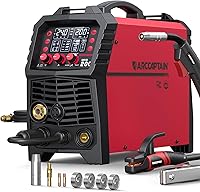
The YESWELDER 205Amp Stick Welder weighs 8.8 lb and has a carry handle. It supports 110V and 220V input, so it can fit more than one workshop power arrangement.
The BILT HARD 135A and YESWELDER 135A are also inverter machines designed around 110V use. Their process choices make them more flexible for general repairs than a single-purpose transformer unit.
A transformer welder can still be the better choice when portability is not important. A machine that stays in one place may not need the lighter design or extra electronic controls.
Which welder is easier to control?
An inverter welder usually gives you more adjustment help, especially when it includes a digital display or synergic control. A transformer can be simpler, but fixed or limited controls may require more manual setup.
The YESWELDER 205Amp Stick Welder has an LED display, a precision value knob, adjustable Hot Start and adjustable Arc Force. Hot Start helps with arc ignition, while Arc Force adjusts current during stick welding.
The BILT HARD 135A adds synergic control. It adjusts voltage and wire speed based on the selected amperage, with 2T, 4T and Spot trigger modes.
The YESWELDER 135A also uses synergic control and adds a voltage micro-adjustment of plus or minus 3V. That can help a beginner start with a recommended setting while still giving an experienced user room to fine-tune the arc.
A basic transformer machine may appeal if you prefer fewer settings. It can also require more attention to manual current selection and process setup.
Does a transformer or inverter welder need more power?
Neither technology should be judged by the label alone. Check the exact voltage, amperage range, circuit capacity and welding process before you connect a machine.
The YESWELDER 205Amp Stick Welder supports both 110V and 220V. Its 205A maximum output gives it more headroom than the 135A machines, but the usable output still depends on the input and the job.
The BILT HARD 135A and YESWELDER 135A are built for 110V operation. That can suit a home garage or repair area with a compatible household outlet, but you should still follow the machine's electrical instructions.
A 110V welder does not mean every outlet or extension setup is suitable. Avoid guessing about circuit capacity, and have an electrician check an unsuitable connection.
For more selection factors, use How to Choose a Welding Machine: Explained.
Which is better for portability?
Choose an inverter welder when you carry the machine between work areas. Compact weight can matter when the work is outside, on equipment or far from your main bench.
The YESWELDER 205Amp Stick Welder is the lightest metal welder in this comparison at 8.8 lb. It has a compact design, carry handle and support for stick and Lift TIG work.
The YESWELDER 135A weighs 11.4 lb according to its product description and supports flux core MIG, Lift TIG and stick welding. Its gasless flux core setup can suit outdoor work where shielding gas would be inconvenient.
The BILT HARD 135A offers 3-in-1 operation, but its listed specifications give an item weight of 76 lb. Its product description also describes a 10.45 lb compact unit, so verify the shipping or package weight before planning transport.
A transformer welder can still be portable in a broad sense, but its traditional power design often makes it less convenient to move than a compact inverter.
Which model suits a small metal workshop?
The YESWELDER 205Amp is the strongest fit here for portable stick work, while the 135A inverter models suit lighter 110V multi-process jobs. Choose by the metal, process and outlet you use most.
The YESWELDER 205Amp supports most 6010, 6011, 6013 and 7018 welding rods. It is intended for stainless steel, mild steel and other metal materials, with Hot Start, Arc Force and Anti-Stick controls.
The BILT HARD 135A supports flux core MIG, Lift TIG and stick welding. It includes a solar-powered helmet, a 6.6 ft MIG gun with a pre-installed 0.030 in tip, a 10 ft ground clamp, 2 lb of flux core wire, a spare 0.035 in tip and a brush and hammer.
The YESWELDER 135A supports gasless flux core MIG, Lift TIG and stick. It includes E71T-GS flux core wire in .030 in and .035 in sizes, an electrode holder, a ground clamp and a MIG torch.
Use {{product B086SNKTTK | A strong match for portable stick welding when you want 205A output, dual-voltage support and adjustable arc controls.}}
Use {{product B0DCW3ZKB3 | A useful 110V choice when you want flux core MIG, Lift TIG and stick welding with synergic control.}}
Use {{product B08CBBHFX5 | A beginner-friendly option for 110V gasless flux core work with stick and Lift TIG modes available.}}
Where does a transformer plastic welder fit?
A plastic welder solves a different problem from a transformer or inverter metal welder. The ATOLS Upgraded Plastic Welder uses a pure copper transformer to heat staples for plastic repairs.
It is designed for bumper, dashboard, lamp holder, radiator, spoiler, handle, headlight and other plastic repairs. The kit includes 1000 staples, pliers, a utility knife and a carrying case.
The tool heats in 1–2 seconds after you select the correct staple and press the power button. Its staple types include flat, wave, inside-corner and outside-corner options in the stated quantities.
At 2.18 lb, it is much lighter than a metal welding machine. That makes it suitable for plastic repair tasks, but it isn't a substitute for an arc welder when you need to join steel.
Use {{product B091T368MK | A focused choice for plastic repair when you need a staple-based repair tool rather than a metal arc welder.}}
How should you compare welding controls?
Match the controls to your experience and process. A display and guided adjustment can shorten setup, while a simpler machine may suit a user who already knows the needed current and technique.
For stick welding, Hot Start can help start the arc and Arc Force can help maintain it. The YESWELDER 205Amp provides both controls with 1–10 adjustment levels.
For flux core MIG, synergic control can connect amperage, voltage and wire speed. Both 135A inverter models include this type of control, though their included accessories and process details differ.
For plastic repair, the useful controls are different. The ATOLS tool focuses on staple selection, rapid heating and safe placement into the plastic.
Don't choose by the display alone. Confirm that the machine supports the rods, wire or repair material you actually plan to use.
What care does each welder need?
Keep any welder clean, dry and within its operating limits. Allow ventilation around the machine, protect cables from damage and let thermal protection work before restarting.
Inspect the electrode holder, ground clamp, MIG gun and power cable before use. Replace damaged parts rather than continuing with exposed conductors or loose connections.
For inverter machines, avoid blocked cooling openings. The BILT HARD 135A uses error codes for overcurrent and overheat, then continues cooling for 1–2 minutes before a safe restart.
For stick work, store electrodes as directed for their type and keep the work area free of flammable materials. For flux core work, choose the wire size and polarity required by the machine and wire instructions.
The ATOLS plastic welder needs a different care routine. Keep its staple holder and working area clear, use the correct staple type and allow heated parts to cool before storage.
Wear the protective equipment required for the process. Welding arcs, hot metal, fumes and heated plastic all require different precautions, so follow the machine and consumable instructions.
Is an inverter welder better for outdoor work?
An inverter welder is often easier to use outdoors because it is lighter and some models support gasless flux core welding. Outdoor conditions still affect safety, visibility, power and weld quality.
The YESWELDER 135A is designed for gasless flux core MIG, which avoids the need for a shielding gas cylinder. That can simplify transport for outdoor or windy work.
The YESWELDER 205Amp supports portable stick welding and dual-voltage input. Stick welding can suit repairs where carrying a wire feeder and gas setup would add complexity.
Outdoor use does not remove the need for a suitable power source. Keep connections dry, secure the workpiece and follow the manufacturer's instructions for the environment.
For a narrower voltage choice, compare Best 110V Welders. If inverter technology is your priority, see Best Inverter Welding Machines.
What should you choose: welder transformer or inverter?
Pick an inverter welder when portability, 110V operation, digital controls or multi-process work matter most. Pick a transformer design when the machine will stay in a fixed workshop and simple power technology fits your routine.
Choose the YESWELDER 205Amp for portable stick welding, 205A output and 110V or 220V support. Choose the BILT HARD 135A for 110V flux core MIG, Lift TIG and stick work with synergic control.
Choose the YESWELDER 135A for beginner-focused gasless flux core welding with access to 2 additional processes. Choose the ATOLS transformer plastic welder only for staple-based plastic repairs.
The best transformer vs inverter welder decision is not about one technology winning every job. Match the machine to your material, process, outlet, movement and control needs, then review [What Is an Inverter Welder?
Tips to Know](/what-is-an-inverter-welder/) before you decide.
Frequently asked questions
Is an inverter welder better than a transformer welder?
An inverter welder is usually the better fit when you need lower weight, 110V operation or adjustable digital control. A transformer welder can suit a fixed workshop where simple controls, steady input power and long service use matter more than portability.
Compare the exact machine and process before choosing.
What is the main difference between a transformer and inverter welder?
A transformer welder uses a larger transformer-based power design, while an inverter welder changes incoming power through electronic switching and control components. In daily use, that difference often appears as a heavier versus lighter machine, simpler versus more adjustable controls, and different power requirements.
Can an inverter welder run on 110V?
Some inverter welders support 110V, but not all do. The YESWELDER 205Amp Stick Welder supports 110V and 220V, while the BILT HARD 135A and YESWELDER 135A models use 110V input.
Check the machine's electrical requirements and your circuit before connecting it.
Are transformer welders good for beginners?
A transformer welder can work for a beginner if its process and controls match the job, but weight and fixed settings may make setup less convenient. An inverter with an LED display or synergic control can make adjustments easier, especially for users learning flux core MIG or stick welding.