Best 110 Volt Welders: Top 9 Picks (November 2026)
The best 110 volt welders include the ARCCAPTAIN 200A MIG Welder 110V 220V for process variety, the YESWELDER 160A MIG Welder for dual-voltage MIG, and the BILT HARD 135A 3-in-1 IGBT Inverter Welder for a ready-to-weld kit.
On this page (3 sections)
The ARCCAPTAIN 200A MIG Welder 110V 220V is the best 110 volt welder for a household shop that wants several processes in one machine. For simpler needs, choose a single-process stick welder or a focused 110V flux core MIG model.
Household voltage can power useful repair work, but it shapes what a machine can do. The process, circuit, duty cycle and material thickness matter as much as the amperage printed in a product name.
If you're new to machine types, start with What Is a Welding Power Source? The Basics.
It explains how the power source fits into the rest of a welding setup.
Our picks at a glance
-
1
-
2

-
3
 Best for a ready-to-weld kit
BILT HARD 135A 3-in-1 IGBT Inverter Welder
9.6/10 our score
See it on Amazon
- 4
 Best for portable flux core MIGCheck it
- 5
 Best for stick and lift TIGCheck it
- 6
 Check it
Hpoouo 200Amp 20PCS Rods Stick Welder
Best for a compact starter kit - 7
 Best for fine-tuning MIGCheck it
- 8
 Check it
Saker Portable Electric Welding Machine
Best for handheld stick repairs - 9
 Best for a portable dual-voltage stick setupCheck it
Which 110 volt welders stand out for home use?
The best 110 volt welders here are multi-process MIG machines for flexibility and compact stick machines for straightforward repairs. We compared the stated input voltage, welding processes, controls and included accessories to match each option to a practical use.
Our score weighs specs, features and buyer feedback against what you're shopping for. It does not mean every machine fits every job, and the right choice depends on your process and electrical setup.
| Product | Best for | Our score |
|---|---|---|
| ARCCAPTAIN 200A MIG Welder 110V 220V | process variety | 9.7 |
| YESWELDER 160A MIG Welder | dual-voltage MIG | 9.6 |
| BILT HARD 135A 3-in-1 IGBT Inverter Welder | a ready-to-weld kit | 9.6 |
| YESWELDER 135A MIG Welder | portable flux core MIG | 9.5 |
| ARCCAPTAIN Stick Welder | stick and lift TIG | 9.4 |
| Hpoouo 200Amp 20PCS Rods Stick Welder | a compact starter kit | 9.3 |
| bestarc 145A MIG Welder | fine-tuning MIG | 9.1 |
| Saker Portable Electric Welding Machine | handheld stick repairs | 9.0 |
| SOARFLY Stick Welder | a portable dual-voltage stick setup | 8.8 |
Best 110 volt welder for process variety: ARCCAPTAIN
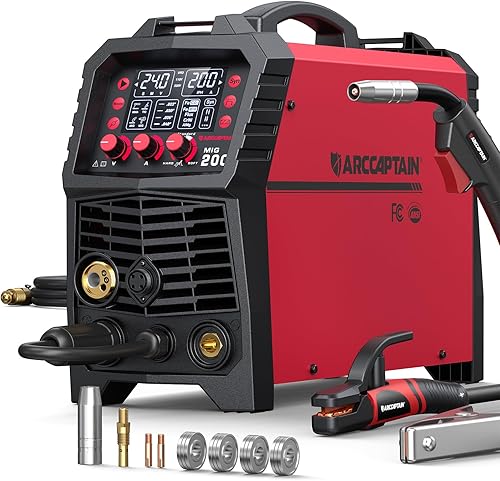
ARCCAPTAIN 200A MIG Welder 110V 220V: Best for process variety
- 110V and 220V input
- Gas and gasless MIG, stick, spot and lift TIG
- Digital synergic MIG control
- 10 preset settings per welding mode
A broad process range makes this a flexible choice for home projects that may call for MIG, stick, spot welding or lift TIG. Its dual voltage and optional spool gun connector offer room to adapt, though the TIG torch and spool gun are separate.
Pros
- Multiple welding modes
- Dual voltage
- Stores settings for later jobs
Cons
- TIG torch and spool gun are not included
- 110V and 220V input must not be switched while the screen is on
The ARCCAPTAIN is the most adaptable pick in this group because it covers gas and gasless MIG, stick, spot welding and lift TIG. It accepts 110V or 220V input, so it can stay useful if you later move the machine to a workspace with different power.
Its synergic MIG control recommends current and wire feed speed based on wire diameter and gas material. You can adjust current to suit your preferences, and the machine stores 10 preset settings for each welding mode.
The maker says the cooling fan runs only when needed. It also includes a display, shoulder strap and safety protections, while the TIG torch and spool gun are separate accessories.
Choose it if you expect to use more than one welding process or want dual-voltage flexibility. Follow its instruction not to switch input voltage while the screen is on.
Best dual-voltage MIG option: YESWELDER 160A
YESWELDER 160A MIG Welder: Best for dual-voltage MIG
- 110V and 220V input
- Flux core MIG, gas MIG, stick and lift TIG
- Synergic and manual controls
- Works with 2 lb and 10 lb wire spools
This YESWELDER combines four processes with both household and 220V input. Synergic controls give beginners a starting point, while manual wire speed and voltage adjustments allow more direct control.
Pros
- Four welding processes
- Automatic and manual control
- Supports two common spool sizes
Cons
- Lift TIG torch must be bought separately
- Heavier than the compact stick picks
The YESWELDER 160A combines gas MIG, flux core MIG, stick and lift TIG with 110V and 220V input. It works with 2 lb and 10 lb spools of .030 in and .035 in solid or flux core wire.
Synergic control recommends voltage and wire feed speed based on the selected thickness or amperage. Manual controls also let you set voltage and wire speed yourself, which can be useful as your technique improves.
It weighs 19.4 lb according to the maker and includes a carrying handle. The lift TIG torch is an extra purchase, so treat that mode as an option rather than a complete TIG setup out of the box.
Pick it if you want dual-voltage MIG and a manual control path. Compare it with other options in our best 200 amp welding machine guide if you expect to use a higher-output machine.
Best ready-to-weld kit: BILT HARD 135A
BILT HARD 135A 3-in-1 IGBT Inverter Welder: Best for a ready-to-weld kit
- 110V flux core MIG, stick and lift TIG
- Synergic control
- LED display
- Includes a solar-powered helmet and 2 lb flux core wire
The 110V-only BILT HARD pairs flux core MIG and stick with lift TIG capability. Its included helmet, wire and basic accessories can help a new buyer assemble a starter setup.
Pros
- Helmet and flux core wire included
- Synergic control
- MIG, stick and lift TIG modes
Cons
- TIG torch is not included
- No 220V input
The BILT HARD 135A is a 110V machine with flux core MIG, stick and lift TIG modes. Its synergic control adjusts voltage and wire feed speed based on amperage, and the LED display shows current, voltage and wire speed.
The package includes a solar-powered helmet, 2 lb flux core wire, a MIG gun, ground clamp, brush and hammer. The TIG torch is not included, so the included accessories are most useful for buyers starting with MIG or stick.
Its stated modes include 2T, 4T and spot trigger settings. The manufacturer describes automatic shutdown with error codes for overcurrent or overheating.
Choose it if having a helmet and starter supplies in the box matters. It does not support 220V input, so check your available circuit and future needs before choosing it over a dual-voltage machine.
Best portable flux core MIG: YESWELDER 135A
YESWELDER 135A MIG Welder: Best for portable flux core MIG
- 110V flux core MIG, stick and lift TIG
- Synergic control with voltage adjustment
- 11.4 lb stated unit weight
- Includes flux core wire
This 110V YESWELDER is a focused option for flux core MIG, with stick and lift TIG available too. Its maker lists 11.4 lb for the machine, and the kit includes flux core wire for getting started.
Pros
- Several processes in one machine
- Voltage micro-adjustment
- Flux core wire included
Cons
- Lift TIG torch is extra
- No 220V input
This YESWELDER is a 110V option for flux core MIG, stick and lift TIG. Its synergic control matches a recommended voltage to wire feed speed, with a small voltage adjustment for manual tuning.
The package includes E71T-GS flux core wire in .030 in and .035 in sizes. The maker describes it as suitable for mild steel up to 3/32 in thick, and gives a machine weight of 11.4 lb.
Lift TIG requires an extra torch. If your main task is indoor MIG with shielding gas, confirm that the exact setup you want is supported before buying, since this model is described around gasless flux core use.
Choose it for a portable 110V setup centered on flux core wire. For broader inverter choices, see Best Inverter Welding Machines.
Best for stick and lift TIG: ARCCAPTAIN Stick Welder
ARCCAPTAIN Stick Welder: Best for stick and lift TIG
- 110V and 220V input
- Stick and lift TIG modes
- Synergic current control
- Hot start, arc force and anti-stick
This ARCCAPTAIN centers on stick welding, with lift TIG as a second process when you add a torch. Dual voltage suits a buyer who may have access to 220V at another work area.
Pros
- Stick-focused controls
- Dual voltage
- Includes shoulder strap
Cons
- TIG torch is not included
- No MIG mode
This ARCCAPTAIN stick welder supports 110V and 220V input, with lift TIG as a second mode. Its synergic control matches current and voltage after you select the electrode diameter, while hot start and arc force can be adjusted.
The machine weighs 7.2 lb according to the manufacturer and includes a shoulder strap. For welding away from an outlet, compare engine-driven welders.
It is a focused alternative to multi-process MIG machines for outdoor maintenance, farm work, garage projects and home DIY.
Lift TIG requires a separate torch. Choose this machine when stick welding is your main process and the ability to use 220V later is useful.
Best compact starter kit: Hpoouo stick welder
Hpoouo 200Amp 20PCS Rods Stick Welder: Best for a compact starter kit
- 110V stick welding
- 20 welding rods included
- Hot start, arc force and anti-stick
- Stated size 7.8 x 3.9 x 5.3 in
Hpoouo offers a small stick-welding package with rods, gloves and chip hammers included. It is aimed at home repairs and DIY, with current adjustment described from 20A to 200A.
Pros
- Rods and gloves included
- Compact stated dimensions
- Common stick-welding aids included
Cons
- 110V only
- No MIG process
Hpoouo is a 110V stick welder that comes with 20 rods, gloves and two chip hammers. Its stated current adjustment runs from 20A to 200A, and it includes hot start, arc force and anti-stick functions.
The maker gives dimensions of 7.8 x 3.9 x 5.3 in and a weight of 3.7 lb for the welder. It describes the machine for home repairs and DIY, with rod types that include E6013, E6011, E6010 and E7018.
Rod polarity depends on the electrode type, so follow the rod maker's instructions and the machine manual. Choose this kit if stick welding fits your work and you want some consumables included.
Best fine-tuning MIG option: bestarc 145A
bestarc 145A MIG Welder: Best for fine-tuning MIG
- 110V and 220V input
- Gas MIG, flux core MIG, lift TIG and stick
- Synergic control with voltage adjustment
- Shoulder strap included
This bestarc machine offers four processes and dual voltage, with a small voltage adjustment range for dialing in MIG settings. It suits buyers who want more control than a basic synergic setup.
Pros
- Four welding processes
- Dual voltage
- Manual voltage adjustment
Cons
- More modes to learn than a simple stick machine
- No confirmed included TIG torch
The bestarc 145A supports gas MIG, flux core MIG, lift TIG and stick welding, with both 110V and 220V input. Its synergic controls set recommended voltage and wire feed speed, and the voltage can be adjusted by -3V to +3V.
That adjustment gives you a way to fine-tune the MIG arc after starting with the automatic settings. The package includes a MIG torch, ground clamp, stick holder, wire, rollers, hose and a 220V-to-110V adapter.
Choose it if you want four processes and a small manual adjustment range. Confirm the setup for any lift TIG work before buying, since a TIG torch is not identified among the included parts.
Best handheld stick repair machine: Saker
Saker Portable Electric Welding Machine: Best for handheld stick repairs
- 110V stick welding
- 20A to 120A adjustment
- Five current settings
- Stated weight 3.3 lb
The handheld Saker is a small stick option for basic repair jobs where portability matters. Its 20A to 120A adjustment and support for 3/32 in rods make its intended range clearer than a general-purpose MIG machine.
Pros
- Handheld format
- Five current settings
- Hot start arc ignition
Cons
- Stick welding only
- Lower stated output range than the other stick picks
The Saker is a handheld 110V stick machine with five current settings from 20A to 120A. It supports 3/32 in rods and includes hot start arc ignition.
Its compact design is intended for home DIY, automotive repair, fencing and general metal repair. The manufacturer gives a weight of 3.3 lb, which suits a buyer who values easy carrying over multiple processes.
Choose it for small repair jobs where stick welding is enough. It is not a MIG machine, and its stated output range is lower than the other stick options here.
Best portable dual-voltage stick setup: SOARFLY
SOARFLY Stick Welder: Best for a portable dual-voltage stick setup
- 110V and 220V input
- Stick welding
- Supports 2.5–3.2 mm electrodes
- Includes rods, gloves and ground accessories
SOARFLY is a portable stick machine for buyers who want a kit and both household and 220V input. It includes common welding accessories, though 220V use requires an adapter that is not included.
Pros
- Dual voltage
- Portable stated weight
- Several accessories included
Cons
- 220V adapter is not included
- No MIG mode
The SOARFLY stick welder accepts 110V or 220V input and supports electrodes from 2.5 to 3.2 mm. Its listed features include hot start, arc force and anti-stick, with a display for current and welding mode.
The package includes 10 rods, gloves, an electrode holder, ground clamp and brush. The maker says a 220V adapter is required for 220V use and is not included.
Pick it if you want a portable stick kit that can use either input voltage. For 220V use, plan for the required adapter and confirm compatibility before connecting it.
How should you choose a 110V welding machine?
Choose the machine by process first, then check voltage, circuit needs and the workpiece. A larger amperage number alone does not show how long the machine can weld or what thickness it can handle.
Is MIG or stick better on household voltage?
MIG is a good fit when you want continuous wire feed and a range of flux core or gas options. Flux core avoids a separate shielding gas supply, while gas MIG needs a compatible gas setup.
Stick welding uses coated electrodes and has fewer setup parts. It can suit outdoor repairs and mobile work, but you need to match rods and settings to the metal and joint.
What does dual voltage add?
A dual-voltage welder can accept either household 110V input or 220V input when set up as directed. It gives you more flexibility across work areas, though the machine's output and duty cycle depend on the input and operating conditions.
A 110V-only machine can still be the right choice if your work stays within its process and output range. Read our transformer vs inverter welder comparison to understand one design choice that affects machine size and power conversion.
How much output do home repairs need?
There is no single amperage that fits every home repair. Thin sheet, a small bracket and a thicker structural repair have different process and preparation needs.
Check the manufacturer's material guidance and duty cycle, and use a circuit suited to the machine. For exhaust repairs, our best welders for exhaust pipes guide focuses on the material and access issues involved.
What should you check before buying?
Confirm the input voltage, included torch or holder, wire or rod compatibility, and whether accessories for the process you want are included. Also check the manual's circuit, extension cord and duty cycle guidance.
For a broader checklist covering process, material and output, read How to Choose a Welding Machine – Explained. Compare that advice with your planned jobs before you pick a machine based on a headline amperage.
Which 110 volt welder should you choose?
Choose the ARCCAPTAIN 200A if you want several processes and dual-voltage flexibility. Pick YESWELDER 160A for a four-process MIG setup with manual controls, BILT HARD for a 110V starter kit, or a compact stick machine when portability and simple repairs matter most.
Our top 3 picks at a glance
-
1
-
2
-
3
Best for a ready-to-weld kit
BILT HARD 135A 3-in-1 IGBT Inverter Welder
9.6/10 our score
See it on Amazon
Frequently asked questions
Can a 110V welder run from a household outlet?
A 110V welder is designed for household voltage, but the outlet and circuit still need to meet the machine's requirements. Check the manual for the recommended circuit and extension cord guidance.
Avoid sharing a circuit with other high-draw tools while welding.
Is MIG or stick better for a 110V welding machine?
MIG is often easier to learn and can be a practical choice for clean indoor work or flux core use outdoors. Stick machines have fewer setup parts and suit repairs where portability matters.
Choose by material, location, and how much setup you're willing to manage.
Can a 110V welder use 220V power?
Only a dual-voltage welder can use both 110V and 220V input. Several picks here support dual voltage, while the BILT HARD and some compact machines are specified for 110V only.
Follow the manufacturer's instructions when changing input voltage.
What can a 110V welder handle?
A 110V welder can handle many home repairs and light fabrication tasks, depending on its process, output, duty cycle and the material thickness. Check the machine's stated limits and use proper joint preparation.
For thicker material, a suitable 220V machine may provide more working range.
Do I need gas with a 110V MIG welder?
No. Flux core MIG uses wire with flux and does not require shielding gas.
Gas MIG needs a compatible gas setup, while stick welding uses coated electrodes.
Check which process and accessories a specific machine supports before choosing it.


