9 Best High Frequency TIG Welders (November 2026)
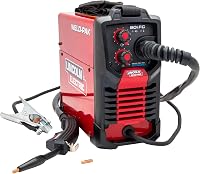
The best high frequency TIG welders include the S7 200A TIG Welder for simple garage repairs, the YESWELDER 205A MIG Welder for mixed welding jobs, and the Weldpro Omni210 MIG Welder 200A Multi-Process Welder for advanced multi-process work.
On this page (3 sections)
The best high frequency TIG welder for most buyers is the Weldpro 200A AC/DC TIG Welder with Pulse because it offers HF AC and DC TIG, pulse control, dual voltage and a foot pedal.
That combination matters in daily use because AC TIG suits aluminum and other non-ferrous metals, while DC TIG suits steel, stainless steel, mild steel and copper.
Pulse control helps manage heat input on thinner work, and the foot pedal lets you change amperage during a weld without stopping.
Choose the S7 for simpler DC TIG and Stick work, or the FEMEROL if plasma cutting matters too.
Dual voltage also helps if you move between a home garage and a workshop, but you should still confirm the outlet and adapter for each location before you start.
High frequency TIG starting creates a non-contact arc start.
That helps keep the tungsten from touching the work before the arc begins, which suits clean, controlled TIG work on suitable materials.
It also reduces the chance of contaminating the tungsten at the start of a weld, which is useful on visible or precision joints.
Set-up still matters, so check your gas flow, tungsten condition, ground connection and torch consumables before each session.
Clean metal and a steady hand matter just as much, since HF start does not remove the need for good fit-up and practice.
Think about who each type suits before you focus on the headline output.
A home user who mainly repairs steel parts may value simple controls over a long list of pulse and waveform options.
A fabricator who moves between aluminum and steel may value AC and DC in one machine, even if set-up takes a little longer.
Consider how often you will change processes during a project.
If most jobs use one material, a focused machine can keep set-up straightforward and help you learn one process well.
If jobs switch often, a multi-process machine can save space and reduce the need for a second power source.
Look at the workspace you will use day to day.
A compact machine fits a smaller bench or a cart, while a heavier unit may need a fixed spot with room for airflow and cables.
Check what is included so the first session does not stall.
A TIG torch, ground clamp, gas connections and starter consumables let you start sooner, while missing items need to be ordered separately.
Plan for care as part of normal use, not as an afterthought.
Wipe down the machine, check consumables for wear and store the torch and leads so they are not kinked or damaged between jobs.
Allow practice time on scrap material before you work on a finished part.
Learning arc starts, puddle control and travel speed on test pieces will make the controls feel clearer when you move to real work.
If you need the basic process explained first, read What Is a TIG Welder? A Practical Answer.
For a DC-only shortlist, compare our guide to the best dc tig welder.
Our picks at a glance
-
1

-
2

-
3
 Best for advanced multi-process work
Weldpro Omni210 MIG Welder 200A Multi-Process Welder
9.6/10 our score
See it on Amazon
- 4
 Best for lightweight outdoor workCheck it
- 5
 Check it
FEMEROL Plasma Cutter Welder Combo 200A Gas
Best for welding and cutting in one unit - 6
 Check it
Weldpro 200A AC/DC TIG Welder with Pulse
Best for aluminum and precision TIG - 7
 Check it
ARCCAPTAIN TIG Welder AC/DC 200A with Pulse
Best for waveform control - 8
 Check it
Everlast Welders Canada PowerArc 161STH Dual Voltage TIG/Stick
Best for TIG and Stick repairs - 9
 Check it
ARCCAPTAIN TIG 205P Pro Pulse Welder
Best for portable DC pulse TIG
Which high frequency TIG welder is best for most work?
The Weldpro 200A AC/DC TIG Welder with Pulse is the best all-around choice here because it covers aluminum and steel with AC/DC TIG, pulse settings and high-frequency starting.
Its 110V/220V design also gives you more flexibility between a home garage and a workshop.
That range suits buyers who do not want to buy a second machine when a project changes from steel to aluminum.
Pulse settings add control on thin sheet metal by helping limit heat buildup during a pass.
The foot pedal adds another layer of control because you can raise or lower amperage as the joint changes.
HF starting helps keep the start clean and reduces contact with the tungsten before the arc forms.
In practice, this is the pick to consider first if your work mixes repairs, fabrication and thinner precision joints.
You will still need to learn the AC controls for aluminum, so allow time to practice on scrap before working on a finished part.
S7 200A TIG Welder: Best for simple garage repairs
- 200A output
- 110V/220V dual voltage
- DC TIG and Stick welding
- TIG torch, ground clamp and electrode holder included
The S7 combines DC TIG and Stick welding in a compact dual-voltage machine. Its simple controls and included torch suit garage repairs, stainless steel work and mild steel projects.
Pros
- 200A capacity
- Dual-voltage input
- Simple controls and digital current display
Cons
- DC TIG only
- Not the most flexible choice for aluminum TIG
The S7 200A TIG Welder is the simplest high-frequency-style choice for garage repairs, stainless steel work and mild steel projects.
It combines DC TIG and Stick welding with 110V/220V input, so you can use it in different working environments.
Its digital current display and simple controls suit beginners and hobbyists who want fewer settings to manage.
That simplicity helps during set-up because you can set output, check the display and focus on torch angle and travel speed.
The machine works with common TIG consumables, including tungsten electrodes, ceramic cups and collets.
That matters for care because standard parts are easier to replace when a cup cracks or a tungsten needs grinding.
The S7 reaches up to 200A and includes a TIG torch, ground clamp, electrode holder and accessories.
Its compact metal inverter design weighs 18.01 lb and includes overheat and overload protection.
At home, the size suits a smaller bench or a cart, and the protection features help during longer repair sessions.
Choose it when your work is mainly steel, stainless steel or light fabrication.
Since it is a DC TIG machine, buyers who need AC TIG for aluminum should choose one of the AC/DC models below.
YESWELDER 205A MIG Welder: Best for mixed welding jobs
- 205A class output
- 110V/220V dual voltage
- MIG, Flux Core MIG, Spool Gun MIG, Lift TIG and Stick
- Synergic and manual MIG controls
This YESWELDER is aimed at buyers who need MIG first but also want Lift TIG and Stick in one machine. Its dual-voltage design and adjustable MIG controls cover varied home and fabrication tasks.
Pros
- Five welding functions
- Dual-voltage input
- Synergic and manual MIG modes
Cons
- Lift TIG is not HF TIG
- Additional Lift TIG torch and spool gun required
The YESWELDER 205A MIG Welder is a better match for a buyer who needs several welding processes but does not require HF TIG.
It supports Gas MIG, Flux Core MIG, Spool Gun MIG, Lift TIG and Stick.
Its synergic MIG mode matches a recommended voltage to the selected wire-feed speed, while manual controls let experienced users adjust both settings.
That helps beginners get a steadier arc, and the voltage fine-tuning from -3V to 3V gives experienced users room to adjust for travel speed and joint shape.
The wire-feed range is 58 to 858 in/min, which covers a wide range of wire settings in daily use.
This 110V/220V machine has a 200A output and a digital display.
A 220V to 110V adapter, gas hose, ground clamp, electrode holder, MIG torch and MIG torch tips are included.
Pick it for automotive, construction, fabrication and DIY work where MIG is the main process.
It is not a true HF TIG choice, and the additional Lift TIG torch and spool gun are required for those functions.
For care, keep the drive rollers and liner clean so wire feeds smoothly, and check ground contact before each start.
Weldpro Omni210 MIG Welder 200A Multi-Process Welder: Best for advanced multi-process work
- Up to 200A
- 110V/220V operation
- AC/DC HF TIG with pulse
- 6-in-1 welding functions
The Omni210 is the broadest multi-process option here, with AC/DC HF TIG, pulse, MIG, Stick, Flux Core and Spool Gun functions. Its 81.8 lb weight makes it better for a fixed work area than frequent transport.
Pros
- AC/DC HF TIG with pulse
- Six-in-one flexibility
- Foot pedal and TIG torch included
Cons
- Heaviest machine here
- More controls to learn
The Weldpro Omni210 is the most flexible machine in this group, with AC/DC HF TIG, pulse, MIG, Stick, Flux Core and Spool Gun functions.
It is suited to a workshop that wants one unit for aluminum work, steel work and several welding methods.
The machine supports up to 200A for MIG, TIG and Stick.
That output gives headroom for varied thicknesses, but set-up time will grow as you switch processes and check consumables.
Its HF/Lift arc starting, adjustable post-flow, VRD, hot start and arc force controls give you more ways to set up TIG and Stick work.
Post-flow helps protect the weld at the end of a run, while hot start and arc force can make Stick starts easier to manage.
The included parts are an 180A NT MIG Torch, flow meter, ground clamp, KT26 TIG Torch and Weldpro foot pedal.
It supports 110V and 220V operation, although the product data identifies 220V as its power source.
At 81.8 lb and 18.4 x 10.4 x 21.1 in, this is better for a fixed bench or workshop position than frequent transport.
Choose it when process range matters more than low weight.
YESWELDER 135A MIG Welder: Best for lightweight outdoor work
- 135A output
- 110V input
- Gasless Flux Core MIG, Lift TIG and Stick
- 11.4 lb stated weight
This compact YESWELDER fits buyers who want a light 110V machine for gasless Flux Core MIG, Lift TIG and Stick work. Its stated 135A output suits mild steel up to 3/32 in.
Pros
- Lightweight design
- Gasless Flux Core option
- Synergic wire-feed control
Cons
- Lift TIG instead of HF TIG
- Lower output than the 200A-class picks
The YESWELDER 135A MIG Welder is the portable pick for gasless Flux Core MIG, Lift TIG and Stick.
Its 110V input and 11.4 lb stated weight make it easier to move around a garage or outdoor work area.
Its 135A output is suited to mild steel up to 3/32 in, while synergic control matches a recommended voltage to wire-feed speed.
A voltage adjustment of plus or minus 3V gives experienced users some extra arc control.
That helps on thin panels where too much heat can cause burn-through, but practice on scrap is still wise.
The package includes E71T-GS flux core wire in .030 in and .035 in sizes, an electrode holder, ground clamp and MIG torch.
Gasless welding suits windy outdoor work because there is no shielding gas bottle to protect from drafts.
Built-in over-current, overload and overheat protection supports routine use.
Choose it when portability and gasless welding matter most.
It is not a high frequency TIG machine, so select the S7, Everlast or an AC/DC TIG model for non-contact TIG starting.
FEMEROL Plasma Cutter Welder Combo 200A Gas: Best for welding and cutting in one unit
- 200A welding capacity
- 110V/220V dual voltage
- HF TIG and plasma cutting
- 6-in-1 functions
The FEMEROL combines HF TIG, MIG, Stick, Spot welding and plasma cutting for buyers who need one machine for several metal tasks. It also includes a TIG torch, plasma torch, air filter regulator and consumables.
Pros
- HF TIG start
- Plasma cutter built in
- Dual-voltage adapter included
Cons
- More setup areas than a TIG-only machine
- 42 lb machine before considering accessories
The FEMEROL Plasma Cutter Welder Combo is the best fit when you need HF TIG and plasma cutting from the same machine.
It combines MIG, Flux MIG, HF TIG, Stick, Spot welding and plasma cutting in a 6-in-1 design.
Under 220V, it gives an ideal clean cut of 10 mm and a maximum severance cut of 16 mm.
The plasma function uses compressed air and works with stainless steel, alloy steel, mild steel, copper and aluminum.
That makes it useful when a repair needs both cutting a part to size and welding it back into place.
The package includes a 15AK MIG torch, plasma cutting torch with consumables, air filter regulator, TIG torch with consumables, hammer, gas hose, ground clamp, electrode holder, Teflon liner and a 110V to 220V adapter.
Air supply and consumable condition matter for cutting quality, so check filters and torch parts during set-up.
Choose this machine if cutting is a regular part of your work.
If you mainly need precise TIG welding, a dedicated AC/DC TIG machine may be easier to set up and learn.
Weldpro 200A AC/DC TIG Welder with Pulse: Best for aluminum and precision TIG
- 200A AC/DC TIG
- 110V/220V dual voltage
- 0.5 to 200 Hz pulse frequency
- Foot pedal included
The Weldpro 200A AC/DC machine is the strongest fit for aluminum and precision work because it combines HF AC and DC TIG with pulse settings and foot-pedal control. It also handles Stick welding when a second process is useful.
Pros
- AC/DC TIG for aluminum and steel
- Adjustable pulse control
- High-frequency non-contact arc start
Cons
- 61.8 lb stated weight
- More expensive setup in time and controls than basic DC TIG
The Weldpro 200A AC/DC TIG Welder with Pulse is the strongest choice for aluminum and precision TIG work.
Its five modes include HF AC TIG, DC TIG, AC Pulse TIG, DC Pulse TIG and Stick MMA.
The AC controls are designed for aluminum, magnesium and other non-ferrous metals.
Adjustable AC balance, frequency and pulse settings help you clean the oxide layer and control the puddle on thinner material.
Pulse frequency adjusts from 0.5 to 200 Hz, while peak amperage, upslope, downslope and 2T/4T trigger modes give you control over heat input and weld timing.
That control helps reduce distortion and burn-through on sheet metal when you practice the settings.
A rocker-style foot pedal allows real-time amperage changes during a weld.
The accessory kit includes a TIG torch, foot pedal, ground clamp, electrode holder, gas hose, flow meter, tungsten electrodes, ceramic nozzles, collets, back caps and a user manual.
This machine weighs 61.8 lb and measures 17.6 x 7.9 x 16.2 in, so plan for a stable cart or bench.
Choose it when you want HF AC/DC TIG with pulse, especially for aluminum and thin sheet metal.
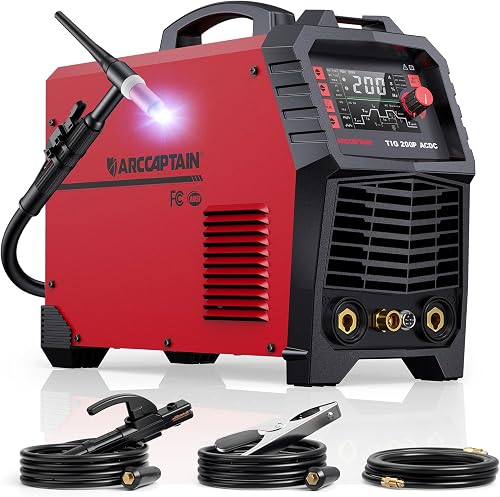
ARCCAPTAIN TIG Welder AC/DC 200A with Pulse: Best for waveform control
- AC/DC TIG
- 200A class machine
- Pulse, square and triangular waveforms
- 0.5 to 5 mm aluminum and 0.5 to 10 mm metals
The ARCCAPTAIN TIG200PACDC suits welders who want AC/DC TIG with pulse, square and triangular waveform options. Its digital controls support detailed adjustment for aluminum, stainless steel, carbon steel and copper.
Pros
- AC and DC TIG
- Three waveform options
- Large LED display
Cons
- Foot pedal is not included
- 42.7 lb stated weight
The ARCCAPTAIN TIG Welder AC/DC 200A with Pulse suits buyers who want detailed waveform control. It supports DC TIG, DC Pulse TIG, AC TIG, AC Pulse TIG, AC Pulse TIG Square, AC Pulse TIG Triangular, Stick and Spot TIG methods.
It covers 0.5 to 5 mm aluminum and 0.5 to 10 mm metals according to the product specifications. Square wave changes polarity quickly for aluminum oxide cleaning, while triangular wave control can reduce heat input for thin metal work.
The digital control system adjusts pre-flow, initial current, upslope, peak current, base current, downslope, crater current, post-flow, pulse duty, AC frequency, AC balance and pulse frequency. A large LED display shows welding parameters.
The package includes a power adapter cord, TIG torch, wire brush, ground clamp, TIG gun accessories set, flow meter and owner's manual. A foot pedal remote control is not included, so choose the Weldpro if hands-free amperage control is essential.
Everlast Welders Canada PowerArc 161STH Dual Voltage TIG/Stick: Best for TIG and Stick repairs
- 140A capacity
- 110V/220V dual voltage
- DC TIG and Stick
- High-frequency start
The PowerArc 161STH is a focused DC TIG and Stick choice with high-frequency start, dual-voltage flexibility and included TIG and Stick accessories. It fits repair work where 140A is enough and AC aluminum TIG is not needed.
Pros
- High-frequency start
- Dual-voltage operation
- 6010/6011 Stick capability
Cons
- Lower output than the 200A machines
- DC power source only
The Everlast PowerArc 161STH is a focused DC TIG and Stick machine with high-frequency start.
Its 110V/220V flexibility suits shop or field use, while its 140A capacity fits repair work that does not need the output of a 200A machine.
It supports DC TIG and Stick welding, including 6010 and 6011 cellulose-based rods.
That Stick capability helps on dirty or rusty repairs, where a cellulose rod can be more forgiving than a TIG-only approach.
VRD adds a voltage-reduction feature, and anti-electrode-stick control helps with arc issues during Stick work.
Included accessories are a 17 series air-cooled TIG torch, argon regulator with hose, 120V/240V adapter, ground clamp, consumable starter kit, Stick electrode holder, impact-resistant carry case and torch switch for 2T/4T operation.
The carry case and adapter help when you move between shop and field locations.
Choose it for repairs and Stick work where DC TIG is enough.
It is not an AC TIG machine, so it is not the right pick for aluminum welding that requires AC.
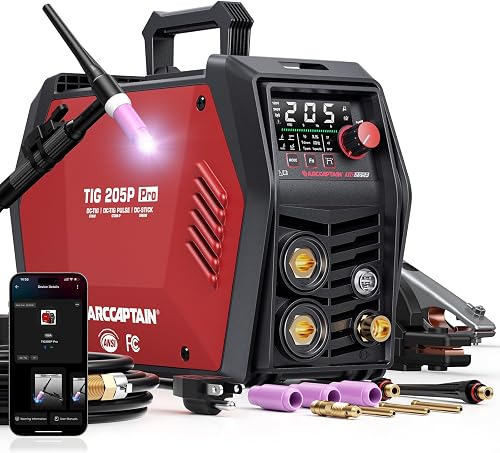
ARCCAPTAIN TIG 205P Pro Pulse Welder: Best for portable DC pulse TIG
- 120V/240V dual voltage
- DC TIG, Pulse TIG, Lift TIG, Spot TIG and MMA
- App control
- Adjustable pulse settings
The ARCCAPTAIN TIG 205P Pro is a portable DC-only machine for thin metal, stainless steel, mild steel and copper. Its app control, pulse settings and 22.8 lb stated weight suit mobile work where aluminum TIG is not required.
Pros
- Lightest stated weight among the TIG-focused picks
- 120V/240V input
- App-controlled settings
Cons
- No AC function for aluminum welding
- Foot pedal is optional
The ARCCAPTAIN TIG 205P Pro is the best portable DC pulse TIG choice in this group.
It supports DC TIG, Pulse TIG, Lift TIG, Spot TIG and MMA, with 120V/240V input and a stated weight of 22.8 lb.
Its app can monitor welder status, select welding modes, adjust parameters, recall presets, analyze error codes and share welding results.
That phone control can help you save settings for repeat jobs, but you should also learn the panel controls for use in a noisy shop.
TIG controls include post-flow, downslope, spot weld time, interval time, pulse frequency, duty cycle, peak current and base current.
Those settings give you detailed control over heat and timing for thin metal work.
The machine suits thin metal, stainless steel, mild steel and copper.
It has no AC function, so it is not suitable for aluminum welding that needs AC TIG.
The package includes a 10 ft earth clamp, 10 ft electrode holder, 110V/220V power adapter, 13 ft WP-26 TIG torch and the TIG205P Pro welding machine.
A foot pedal is optional, so factor that in if hands-free control matters to you.
What should you look for in a high frequency TIG welder?
The most important choices are AC or DC output, input voltage, amperage, pulse control and included accessories. HF starting matters because it begins the arc without requiring the tungsten to touch the work.
Choose DC TIG for steel, stainless steel, mild steel and copper. Choose AC/DC TIG when aluminum or other non-ferrous metals are part of your work, because the AC models here include functions intended for aluminum welding.
Is HF TIG better than lift TIG?
HF TIG is usually the better choice when you want a non-contact arc start.
Lift TIG starts after the tungsten touches and lifts from the work, so it can be useful on simpler machines but requires more control to avoid contamination.
HF start helps on clean, controlled joints because the arc forms without touching the work first.
That can protect the tungsten tip and give a cleaner start on suitable materials.
The YESWELDER 205A and YESWELDER 135A use Lift TIG.
The S7 and Everlast provide focused DC TIG options, while the Weldpro, FEMEROL and AC/DC ARCCAPTAIN models provide HF-related TIG functions.
Your choice should follow the work you do most often.
If aluminum is part of your projects, look for AC/DC HF TIG rather than DC or Lift TIG alone.
If steel repairs are your main work, a focused DC machine may be simpler to set up and maintain.
Also check included torches, foot pedals and consumables, because missing parts can add cost and delay your first weld.
How much amperage do you need?
A 140A machine can suit repairs and thinner work, while a 200A machine gives more room for varied metal thicknesses and demanding projects. Amperage alone does not decide the result, so match the machine to your material, torch setup and power supply.
For a compact 200A garage machine, the S7 is straightforward. For AC/DC TIG, the Weldpro 200A and ARCCAPTAIN TIG Welder offer more control for aluminum and precision work.
Does dual voltage matter?
Dual voltage matters when you may work from both household and higher-voltage outlets. The S7, YESWELDER 205A, FEMEROL, Weldpro 200A, Everlast and ARCCAPTAIN TIG 205P Pro all include dual-voltage input details.
Before welding, confirm the outlet, adapter and power requirements for your setup. Keep the machine on a stable, dry surface with room for airflow, and follow the operating instructions for connections, cooling and shutdown.
What accessories do you need?
You need a TIG torch, ground connection, shielding-gas setup and suitable tungsten and consumables for TIG work. Some machines here include several of those parts, while others need an additional torch or foot pedal for specific functions.
For beginner-focused setup advice, compare the best tig welder for beginners. If brand-specific options matter, see the best miller tig welder guide before deciding.
How do you choose among these high frequency TIG welders?
Choose the Weldpro 200A AC/DC TIG Welder with Pulse for aluminum, pulse control and foot-pedal work.
Choose the S7 200A TIG Welder for simpler DC TIG and Stick repairs, the FEMEROL if plasma cutting is part of the same job, or the ARCCAPTAIN TIG 205P Pro for lighter DC pulse TIG work.
Start by listing the metals you weld most often.
Steel and stainless steel point toward DC TIG, while aluminum points toward AC/DC TIG with HF start.
That first check narrows the field quickly and stops you paying for controls you may never use.
Next, check thickness and project type.
Thinner sheet metal benefits from pulse control and careful heat management, while thicker repairs need enough amperage and a stable power supply.
Think about the joints you make as well as the material.
Long seams, short repairs and thin edges all place different demands on heat control and on how you set amperage.
Then check your space and power.
Dual-voltage machines help if you use different outlets, but weight and size decide whether the machine lives on a bench, a cart or in a carry case.
A fixed workshop position suits a larger machine, while frequent moves suit a lighter unit even if it offers fewer functions.
Match the machine to the room you have, not just to the work you hope to do one day.
Also compare what is in the box.
Look for the TIG torch, ground clamp, gas setup, foot pedal and starter consumables you need for your chosen process.
Missing parts can delay set-up, so treat the contents list as part of the real cost of starting.
Check whether extra torches or pedals are required for a function you plan to use.
Our score weighs specs, features and buyer feedback against what you're shopping for.
Use that score as a starting point, then test it against your material, space and power needs.
A high score does not remove the need to check AC or DC suitability for your main metal.
Check the required input voltage, AC or DC need, included accessories and space for the machine before you order.
Confirm the outlet and adapter for each location where you plan to weld.
Leave room for ventilation and stable placement, and follow the instructions for cooling and shutdown.
Plan a short practice session on scrap after set-up.
That helps you learn the controls in a calm setting before you need them on a finished repair or fabrication.
Our top 3 picks at a glance
-
1
-
2
-
3
Best for advanced multi-process work
Weldpro Omni210 MIG Welder 200A Multi-Process Welder
9.6/10 our score
See it on Amazon