9 Best Generators for Welding (November 2026)
The best generators for welding machines include the WEN for common 120V and 240V jobs, the Westinghouse 12500 Watt Dual Fuel Home Backup for high-demand 240V welders, and the Westinghouse 6500 Watt Dual Fuel Home Backup for midrange 240V output.
On this page (8 sections)
- How we chose generators for welding
- The best generators for welding
- How do you match a generator to a welding machine?
- Does a welder need a 120V or 240V generator?
- Are inverter generators good for welding machines?
- When is an engine-driven welder a better choice?
- How should you set up a generator for welding?
- Which generator should you choose for welding?
The best generator for welding is one that meets your welder’s input demand at the required voltage. For a 120V machine with modest draw, a portable inverter generator may fit; for a compatible 240V welder, look for a generator with matching output and enough continuous watts.
A welder’s advertised output current is not the same as its input power demand. Check its manual or nameplate for input amps, voltage, plug type and generator guidance before choosing a power source.
If you're still comparing the machine itself, our guide to choosing a welding machine covers process, power and portability. For a broader look at mobility, see [What Is a Portable Welder?
A Quick Guide](/what-is-a-portable-welder/).
Our picks at a glance
-
1

-
2
 Best for high-demand 240V welders
Westinghouse 12500 Watt Dual Fuel Home Backup
9.6/10 our score
See it on Amazon -
3
 Best for midrange 240V output
Westinghouse 6500 Watt Dual Fuel Home Backup
9.6/10 our score
See it on Amazon
- 4
 Best for high-output job sitesCheck it
- 5
 Check it
Oxseryn 4400-Watts Inverter Generator
Best for lighter 120V welding setups - 6
 Check it
WEN 6800-Watt Dual Fuel RV-Ready Electric Start
Best for dual-fuel inverter power - 7
 Check it
Oxseryn Power Equipment 4400 Watts Inverter Generator
Best for portable 120V setups - 8
 Check it
BILT HARD 5500W Dual Fuel Inverter Generator
Best for dual-fuel 120V welding - 9
 Check it
Evernexta 4000W Gas-Powered Inverter Generator
Best for compact 120V jobs
How we chose generators for welding
The most useful generator for a welder has enough running watts, the right voltage and a compatible outlet. We compared the stated output, fuel options, outlet details and portability features against common off-grid welding needs.
Peak watts can help describe brief demand, but they don't replace running watts for sustained work. The generator’s output can also change by fuel, so compare the number for the fuel you expect to use.
We also looked at whether an option specifies 120V, 240V or both. A high watt number is not enough if the outlet or voltage does not fit the welder.
Our score weighs specs, features and buyer feedback against what you're shopping for.
| Product | Best for | Running output | Voltage | Outlet | Our score |
|---|---|---|---|---|---|
| WEN | common 120V and 240V jobs | 3800 W gasoline; 3500 W propane | 120V or 240V | L14-30R 30A twist lock | 9.7 |
| Westinghouse 12500 Watt Dual Fuel Home Backup | high-demand 240V welders | 9500 W gasoline; 8500 W propane | 120V/240V outlets | 9.6 | |
| Westinghouse 6500 Watt Dual Fuel Home Backup | midrange 240V output | 5300 W gasoline; 4800 W propane | 120V/240V selector | L14-30R 30A | 9.6 |
| DuroMax XP13000EH | high-output job sites | 10500 W | 9.5 | ||
| Oxseryn 4400-Watts Inverter Generator | lighter 120V welding setups | 3400 W | 9.4 | ||
| WEN 6800-Watt Dual Fuel RV-Ready Electric Start | dual-fuel inverter power | 120V/240V | L14-30R | 9.3 | |
| Oxseryn Power Equipment 4400 Watts Inverter Generator | portable 120V setups | 3400 W | 9.1 | ||
| BILT HARD 5500W Dual Fuel Inverter Generator | dual-fuel 120V welding | 4000 W gasoline; 3600 W LPG | 120V | 8.9 | |
| Evernexta 4000W Gas-Powered Inverter Generator | compact 120V jobs | 3400 W | 8.2 |
The best generators for welding
The WEN leads this group for its combination of selectable 120V/240V output, dual-fuel choice and 3800 running watts on gasoline. The other picks serve buyers who need more output, inverter power or lighter transport.
WEN: Best for common 120V and 240V jobs
- 3800 running watts on gasoline
- 3500 running watts on propane
- 120V/240V selector
- L14-30R outlet
Its 120V/240V selector and L14-30R outlet give it useful connection options for compatible welders. Check the welder’s input draw against the generator’s running watts on your chosen fuel.
Pros
- Switches between gas and propane
- Selectable 120V/240V output
- Wheel and handle kit included
Cons
- Provides 3800 running watts on gas and 3500 on propane
- Weighs 105.8 lb
The WEN DF475T offers 3800 running watts on gasoline and 3500 on propane, with a dial to select fuel and a switch for 120V or 240V. Its L14-30R twist-lock outlet may suit a compatible welder connection, but confirm the machine’s plug and input draw first.
The generator has electric start and a 4-gallon tank. WEN states up to 11 hours of runtime at half load, which is a different load level from welding at full demand.
At 105.8 lb, it is portable with its included wheel and handle kit, though it is not a light carry. The 12V DC outlet is separate from the AC outlets and should not be mistaken for a welder connection.
Choose it for a compatible welder that needs 120V or 240V and fits within its running output. On propane, use the lower 3500-watt figure when checking the load.
Westinghouse 12500 Watt Dual Fuel Home Backup: Best for high-demand 240V welders
- 9500 running watts on gasoline
- 8500 running watts on propane
- L14-30R 30A and 14-50R 50A outlets
- Remote, electric and recoil start
High running output and two 120V/240V outlet options suit compatible welders with larger input demands. Its size and 27.2 x 26.1 x 26.5 in dimensions call for planned transport and storage.
Pros
- High running output on either fuel
- Two 120V/240V outlet types
- Remote start key fob included
Cons
- Large and heavy-duty format
- Welding compatibility still depends on the welder’s input requirements
The Westinghouse 12500 Watt Dual Fuel Home Backup offers 9500 running watts on gasoline and 8500 on propane. Its L14-30R 30A and 14-50R 50A outlets provide two connection options for compatible 120V/240V equipment.
That output may suit a welder with a higher input demand, provided the voltage and outlet match. The unit also has two standard 120V household receptacles, so the panel supports different loads, but total demand still needs to stay within the generator’s capacity.
Remote start, electric start and recoil start give you several ways to start it. The 6.6-gallon tank is rated for up to 12 hours of runtime, though the welding load will affect actual runtime.
At 27.2 x 26.1 x 26.5 in, plan where it will sit and how you will move it. Pick this for a compatible higher-demand welder and a work area where its size is manageable.
Westinghouse 6500 Watt Dual Fuel Home Backup: Best for midrange 240V output
- 5300 running watts on gasoline
- 4800 running watts on propane
- 120V/240V selector
- L14-30R 30A outlet
This dual-fuel model offers a transfer-switch-ready L14-30R outlet and enough running output for some compatible welders. Its output varies by fuel, so use the lower propane figure if that is your planned fuel.
Pros
- Gasoline or propane operation
- 120V/240V selector
- Wheel kit included
Cons
- 135.6 lb
- Running output is lower on propane
The Westinghouse 6500 Watt Dual Fuel Home Backup provides 5300 running watts on gasoline or 4800 on propane. Its 120V/240V selector and L14-30R 30A receptacle make it a midrange option for welders that fit those limits.
It also has an RV-ready TT-30R outlet and a household duplex receptacle. Those outlets serve different connections, so match the welder’s plug and voltage rather than relying on the generator’s total watt number alone.
The 4.7-gallon tank is rated for up to 14.5 hours of runtime. It weighs 135.6 lb, and the wheel kit helps with moving it over suitable ground.
Consider it when your welder’s input stays below the running output for your chosen fuel. If you plan to use propane, base your calculation on 4800 watts.
DuroMax XP13000EH: Best for high-output job sites
- 10500 running watts
- 13000 surge watts
- Gasoline or propane
- Transfer-switch-ready 50A outlet
Its 10,500 running watts place it among the higher-output choices here for welders with demanding input needs. The 234 lb frame makes it a planned move rather than a light carry.
Pros
- High stated running output
- Dual-fuel operation
- No-flat tires and wheel kit
Cons
- 234 lb
- Confirm outlet and voltage match your welder
The DuroMax XP13000EH provides 10,500 running watts and up to 13,000 surge watts, with gasoline or propane operation. It is the highest running-output option in this group, which makes it relevant for a compatible welder with a substantial input demand.
Its control panel includes a transfer-switch-ready 50A outlet and other outlet options. Check the welder’s required voltage and connection before use, since generator capacity does not guarantee every outlet is suitable.
The all-metal frame, no-flat tires and wheel kit support moving it around a work area, but its 234 lb weight means transport needs planning. This is a large generator for occasional light welding.
Choose it when high output is useful and the job site can accommodate a 234 lb unit. For a small 120V welder, its capacity may be more than the task calls for.
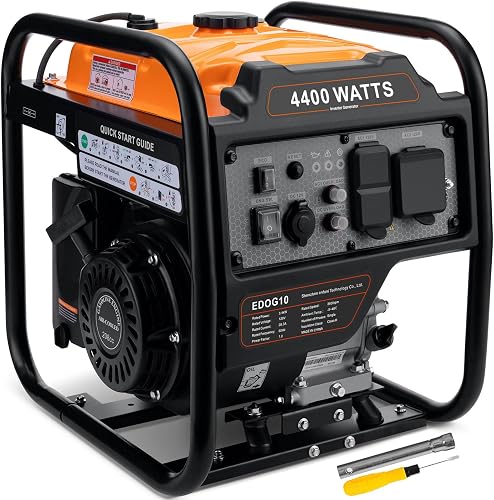
Oxseryn 4400-Watts Inverter Generator: Best for lighter 120V welding setups
- 3400 running watts
- 4400 peak watts
- Two 120V AC ports
- 57 lb
This lighter inverter model suits a compatible 120V welder whose input stays within 3400 running watts. It has two 120V AC ports, but no 240V output is specified.
Pros
- 57 lb listed weight
- Inverter design
- 14 hours stated at 25% load
Cons
- Gasoline only
- No 240V outlet specified
The Oxseryn 4400-Watts Inverter Generator has 3400 running watts and 4400 peak watts in a 57 lb package. It specifies two 120V AC ports, so it is aimed at a compatible 120V setup rather than a welder requiring 240V.
Its 2-gallon tank is stated to provide up to 14 hours at 25% load. Welding is a heavier load than that runtime condition, so don't use the 14-hour figure as a prediction for active welding.
The generator also has a 30A RV port and a 12V DC port. Those are not interchangeable with a welder connection; check the outlet and plug details before choosing it.
This is a lighter choice for a welder whose input fits within 3400 running watts at 120V. It runs on gasoline.
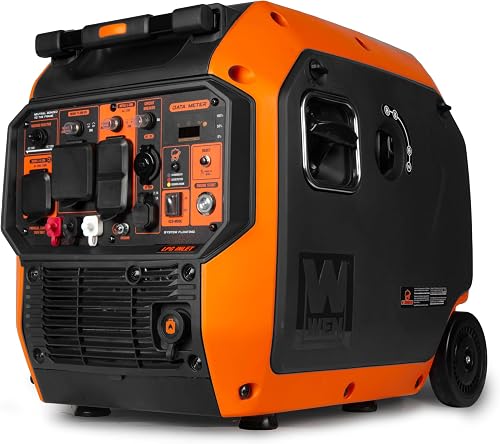
WEN 6800-Watt Dual Fuel RV-Ready Electric Start: Best for dual-fuel inverter power
- 5100 rated watts on gasoline
- 4500 rated watts on propane
- L14-30R 120V/240V receptacle
- CO shutdown sensor
This inverter generator combines dual-fuel operation with a 120V/240V L14-30R receptacle. Its rated output is 5100 watts on gasoline or 4500 watts on propane, so compare the correct figure with the welder’s input.
Pros
- Dual-fuel operation
- 120V/240V receptacle
- Wheels and telescoping handle
Cons
- Weighs 99.2 lb
- Rated output is lower on propane
The WEN 6800-Watt Dual Fuel RV-Ready Electric Start inverter generator provides 5100 rated watts on gasoline and 4500 on propane. Its L14-30R receptacle supports 120V/240V output, which gives it a useful connection type for some compatible welders.
It has additional 120V receptacles, an RV outlet, USB ports and a 12V DC receptacle. Use the L14-30R only when it matches the welder’s voltage and connection requirements.
The unit weighs 99.2 lb and includes onboard wheels and a telescoping pull handle. Its CO shutdown sensor is a safety feature, but it does not replace outdoor placement and safe operation according to the manuals.
Consider it if you want inverter power, dual fuel and 120V/240V output in one generator. Use the rated output for the fuel you plan to run.
Oxseryn Power Equipment 4400 Watts Inverter Generator: Best for portable 120V setups
- 3400 running watts
- 4400 peak watts
- Two 120V AC ports
- 56 lb
At 56 lb, this is one of the lighter options for moving between outdoor work areas. Its 3400 running watts and 120V ports fit only welders with compatible input requirements.
Pros
- 56 lb listed weight
- Inverter generator
- 14 hours stated at 25% load
Cons
- Gasoline only
- No 240V output specified
The Oxseryn Power Equipment 4400 Watts Inverter Generator is a 56 lb option with 3400 running watts. It lists two 120V AC ports, a 12V DC port and an RV port, so confirm that the welder uses a compatible 120V connection.
Its two-gallon tank is stated to provide up to 14 hours at 25% load with ECO mode. That low-load runtime does not describe welding use, where actual fuel use depends on demand.
The generator has overload protection and low-oil shutdown. Those features don't expand its rated capacity, so allow a margin below 3400 running watts rather than planning to operate at the limit.
Choose it for portable 120V work when the welder’s input is within its running capacity. It is gasoline powered.
BILT HARD 5500W Dual Fuel Inverter Generator: Best for dual-fuel 120V welding
- 4000 running watts on gasoline
- 3600 running watts on LPG
- 120V outlets
- CO auto-shutoff
This dual-fuel inverter model provides 120V output and up to 4000 running watts on gasoline. The stated outlet details do not include 240V, so check your welder’s voltage before considering it.
Pros
- Gasoline or LPG
- CO auto-shutoff
- Parallel connectors for two identical generators
Cons
- 120V output only
- Running watts vary by fuel
The BILT HARD 5500W Dual Fuel Inverter Generator supplies 4000 running watts on gasoline or 3600 on LPG. Its listed AC outlets are 120V, so it is a potential fit only for a compatible 120V welder.
It weighs 61.7 lb and includes economy mode, a digital display and CO auto-shutoff. The display cycles through volts, frequency, amps, watts, runtime hours and fuel level, which helps you monitor generator operation.
The product details include parallel connectors for pairing two identical inverter generators. Check the manuals for approved parallel setup and whether it is appropriate for your welding equipment.
Use the gasoline or LPG running-watt figure that matches your fuel when comparing with the welder. The listed outlet details do not specify 240V.
Evernexta 4000W Gas-Powered Inverter Generator: Best for compact 120V jobs
- 3400 running watts
- 4000 starting watts
- Two 120V AC outlets
- 55 lb
Its 55 lb weight and 120V outlets suit portable setups with modest power needs. The 3400 running-watt ceiling is the key figure to compare with your welder.
Pros
- 55 lb listed weight
- Portable inverter design
- 30A outlet included
Cons
- Gasoline only
- No 240V output specified
The Evernexta 4000W Gas-Powered Inverter Generator has 3400 running watts, two 120V AC outlets, a 30A outlet and a 12V DC port. Its 55 lb weight makes it one of the lighter choices here for moving between storage and an outdoor work area.
The stated 4000 starting watts should not be confused with its 3400 running watts. The maker describes up to 9 hours of runtime, while the product details also specify up to 6.5 hours at 50% load; runtime varies with load.
It includes overload protection and low-oil shutdown. The listed outlets do not specify 240V, so this generator is not the right match for a welder that requires 240V input.
Choose it for a compatible 120V welder whose demand stays within 3400 running watts. It runs on gasoline.
How do you match a generator to a welding machine?
Match the generator to the welder’s input amps, voltage and plug, then confirm the generator can supply that load continuously. The welder’s output amperage is not the same as its electrical input demand.
Start with the welder nameplate or manual. If it gives input amps rather than watts, use the manufacturer’s guidance or ask a qualified electrician to help calculate the input demand for the stated voltage.
A generator’s running-watt rating is the key capacity figure for ongoing welding. Peak watts describe short-duration output, and an adequate peak rating does not make up for too few running watts.
Leave room for other equipment. Lights, grinders or a compressor draw power too, and startup demand can be higher than a motor’s running demand.
Does a welder need a 120V or 240V generator?
Use the voltage your welder requires, because a generator with the wrong voltage cannot serve as a suitable power source. Some generators here list only 120V outlets, while others have 120V/240V outlets or a selector.
A 120V generator may work for a compatible small welder with a modest input draw. For machines that require 240V, confirm both the generator’s 240V output and the matching outlet.
Don't rely on adapters to solve a voltage or capacity mismatch. Follow both equipment manuals and use cords sized for the load and distance.
For portable machine choices, compare our guides to the best portable welding machine and the best 110 volt welder. If you use flux-core wire outdoors, our portable flux core welder picks may also help narrow the machine side of the setup.
Are inverter generators good for welding machines?
An inverter generator can be a good fit when its rated output and voltage meet the welder’s input needs. The inverter models in this roundup vary, and some list only 120V output.
Check the welder maker’s instructions for generator compatibility. A generator’s inverter label alone does not confirm it can handle a particular welder or its load changes.
Portable inverter models can weigh less than larger open-frame generators in this selection. Compare weight with output, voltage and outlet type, not by portability alone.
Our guide to the best inverter generator for welder setups focuses on that generator type. You can also compare best portable welder generator options for machines and generator combinations.
When is an engine-driven welder a better choice?
An engine-driven welder can make sense when you want one machine that generates welding power without a separate generator. It may reduce the number of separate units to transport, though the right choice depends on process, output and work needs.
A standalone generator gives you a separate power source that may also run other compatible tools. It also means you need to confirm generator output, outlet and welder input as a matched system.
Compare the purpose-built option in our guide to best engine driven welders before buying a standalone generator. For smaller jobs, consider whether a portable welder and a generator sized to its input will be easier to move.
How should you set up a generator for welding?
Set up the generator outdoors on stable ground, away from doors, windows and vents, and follow its manual for clearance and operation. Generators produce carbon monoxide, so never run one in a home, garage or other enclosed area.
Keep the generator dry and protect connections as the manuals direct. Use an extension cord rated for the welder’s load and length, and inspect plugs and cables before each job.
Start the generator and let it stabilize according to its instructions before connecting the welder. Avoid adding other loads until you know the welding setup stays within the continuous output.
Which generator should you choose for welding?
Choose the WEN if you need selectable 120V/240V and your welder fits within its 3800 gas or 3500 propane running watts. Choose the Westinghouse 12500 Watt Dual Fuel Home Backup or DuroMax for compatible higher-demand welders, and one of the lighter inverter models for a suitable 120V machine with modest draw.
Before you buy, compare the welder’s input requirements with the generator’s running watts, voltage and outlet. For help choosing the machine first, start with [What Is a Portable Welder?
A Quick Guide](/what-is-a-portable-welder/).
Our top 3 picks at a glance
-
1
-
2
Best for high-demand 240V welders
Westinghouse 12500 Watt Dual Fuel Home Backup
9.6/10 our score
See it on Amazon -
3
Best for midrange 240V output
Westinghouse 6500 Watt Dual Fuel Home Backup
9.6/10 our score
See it on Amazon
Frequently asked questions
How many watts does a generator need for a welder?
Start with the welder’s input watts or amps and voltage, then compare its demand with the generator’s running watts. Peak or surge watts describe short-term output and should not be treated as continuous capacity.
Allow room for other connected loads and follow the welder maker’s generator guidance.
Can a portable generator run a 240V welder?
Yes, if the generator provides compatible 240V output through an outlet that matches the welder or an approved connection. Check the generator’s running watts and the welder’s input requirements together.
A 240V outlet alone does not mean the generator can supply enough power for every welder.
Is an inverter generator suitable for welding?
It can be suitable when its rated output, voltage and outlet match the welder’s requirements. The inverter models here vary in output and some specify only 120V ports.
Check the welder manufacturer’s instructions before connecting it, especially if the machine has sensitive controls.
Can I run other tools while welding?
Only if the combined load stays within the generator’s continuous output and the welder maker permits it. Add the input demand of each tool, including any startup demand, before running them together.
When the load is close to the generator limit, use one tool at a time.
What outlet should I look for on a welding generator?
Choose an outlet that matches the welder’s voltage, plug and current needs. Some generators here include an L14-30R 120V/240V outlet, while several inverter options list 120V outlets only.
Never force a plug or improvise an adapter; check the equipment instructions or ask a qualified electrician.


