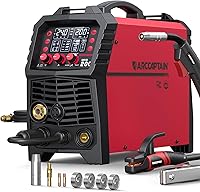
Titanium MIG 170 Welder Review: Worth It? (November 2026)
The Titanium MIG 170 is worth considering if you need a dual voltage MIG welder for flexible workshop use. Confirm its supported processes, output, duty cycle, and included accessories before buying, since those details aren't established here.
On this page (6 sections)
The Titanium MIG 170 is worth considering if you need a dual voltage MIG welder for flexible workshop use. Before choosing it, confirm its input requirements, output range, duty cycle, process options, and included accessories for your kind of work.
Dual voltage can make a machine easier to place in a workshop with more than one suitable power supply. It doesn't by itself tell you how thick a material the welder can handle or how long it can run at a given output.
What does the Titanium MIG 170 offer?
The Titanium MIG 170 is a dual voltage MIG machine aimed at flexible workshop use. Check its manual for the exact voltage options and performance details before matching it to a job.
USWELDWIRE 180A Mig Welding Gun Fits Titanium: Best for a replacement gun

- Fits Titanium Unlimited 200, 170 and 140 welders
- 5-pin connector
- For flux-cored and gas-shielded MIG
A replacement MIG gun option for compatible Titanium Unlimited 170 welders. It includes a 10 ft gun, 20 contact tips, a nozzle and a tip holder.
Pros
- Compatibility includes the Titanium Unlimited 170
- Works with flux-cored and gas-shielded processes
- Includes contact tips, nozzle and tip holder
Cons
- Compatibility is stated for Titanium Unlimited models, so check your exact welder
- A replacement gun does not answer questions about the welder's output or duty cycle
A compatible replacement gun can matter if the original is damaged or you want a spare. The USWELDWIRE gun is described as fitting Titanium Unlimited 170, 140, and 200 welders, with a 5-pin connector and consumables for flux-cored and gas-shielded MIG.
Make sure the exact model name matches your machine. Similar model numbers don't always mean that a gun, connector, or consumable will fit.
For a quick refresher on the process, see What Is a MIG Welder? Signs to Watch For.
Does dual voltage make it a good workshop choice?
Dual voltage can make a welder more adaptable to workshop power options, provided the machine supports the outlets and circuits available to you. Verify the input requirements in the manual rather than relying on a general description.
A higher voltage supply may matter for demanding work, but the outlet, breaker, wiring, and extension cord also need to meet the manufacturer's requirements. Don't assume an adapter makes an unsuitable circuit safe.
Think about where you'll weld most often. A fixed bench setup, a garage with limited outlets, and a portable repair kit have different power and storage needs.
The Titanium's voltage options alone don't guarantee its maximum output, duty cycle, or suitable material thickness. Check those specifications against the jobs you plan to do.
What should you verify before buying?
Check the output range, duty cycle, and supported wire sizes against your typical projects. These details help show whether the machine can complete your work without frequent pauses or an unsuitable weld setup.
Confirm whether the welder supports gas-shielded MIG, flux-cored wire, or both. If you plan to weld outdoors, flux-core may be useful because it doesn't rely on shielding gas, though it still creates fumes and spatter.
Look at what's included and what you'll need separately. A welder may require a gas regulator, shielding gas, wire, a suitable power cord, or protective gear depending on the process and package.
Also confirm warranty terms and service availability with the manufacturer or seller before purchase. A clear local repair path can matter when a workshop depends on its equipment.
How does it compare with other MIG welders?
The right alternative depends on power access, process needs, and the details you can verify. For another brand comparison, see Miller MIG welders.
Compare documented specifications rather than using amperage or a feature count alone.
The YESWELDER 135A is a 110V, 135A machine for flux-core MIG, stick, and lift TIG; its TIG torch is extra. That makes it a smaller-power alternative when a standard 110V setup is the priority.
The YESWELDER 205A has stated 110V/220V input and 200A output, plus gas MIG, flux-core MIG, spool-gun MIG, lift TIG, and stick modes. A spool gun and lift TIG torch are required for those added processes.
Browse Best ARCCAPTAIN MIG Welders and Best Lincoln MIG Welders for more brand options. If portability and inverter design matter, compare Best Inverter MIG Welders.
For another multi-process comparison, read the YESWELDER MIG-250 Pro Review.
Is the Titanium MIG 170 right for your projects?
Choose the Titanium MIG 170 if its confirmed voltage, output, process support, and duty cycle match your regular work. A flexible power setup helps only when the machine's documented performance also fits the metal and welds you need.
For occasional light projects on 110V, a lower-output machine may be easier to move and store. For varied processes, compare what each machine supports and the cost and availability of any extra torch or spool gun.
Before buying, write down your common material types and thicknesses, expected session length, and available circuits. Use those needs to check the manual's limits, then confirm that compatible consumables and replacement parts are available.
The replacement USWELDWIRE 180A MIG gun for Titanium welders may help if your compatible Titanium gun needs replacing. Verify the model and connector first.
Verdict: should you choose the Titanium MIG 170?
Choose the Titanium MIG 170 if its confirmed specifications fit your workshop power and welding tasks. If you need a machine with clearly stated output and process options for comparison, consider the YESWELDER 205A; for lighter 110V work, compare the YESWELDER 135A.
Use the YESWELDER MIG-250 Pro review to compare another multi-process machine, and check the Titanium manual before you commit to a setup.
Frequently asked questions
Is the Titanium MIG 170 a dual voltage welder?
The Titanium MIG 170 is described here as a dual voltage machine, which can suit a workshop that may use more than one supply. Check the manual or manufacturer details for the supported input voltages, plug requirements, and circuit needs before connecting it.
What should I check before buying a Titanium MIG 170?
Confirm the exact model, input voltage, output range, duty cycle, supported wire types, and included accessories. Those details determine whether the welder fits your material thickness and work schedule; also check local service options and the manual's setup requirements.
Can you replace the Titanium MIG 170 gun?
The USWELDWIRE 180A replacement gun is described as fitting Titanium Unlimited 170, 140, and 200 welders. It has a 5-pin connector and supports flux-cored and gas-shielded MIG, but verify that your exact Titanium model matches before ordering.
How does the Titanium MIG 170 compare with a YESWELDER 205A?
The YESWELDER 205A has stated 110V and 220V input, 200A output, and five process modes, including spool-gun MIG and stick. Compare those documented details with the Titanium's manual and your work needs; the YESWELDER requires an extra spool gun and lift TIG torch for those modes.