9 Best Dual Voltage Wire Feed Welders (November 2026)
The best dual voltage wire feed welders include the FORNEY Easy Weld 140 Amp 120-Volt Flux-Cored for simple household flux-core work, the ARCCAPTAIN 200A MIG Welder 110V 220V for multiple welding modes, and the PRIMEWELD MIG180 Mig Welder for aluminum and stick options.
On this page (6 sections)
The best wire feed welder 110V/220V choice for varied home and shop jobs is the ARCCAPTAIN 200A MIG Welder 110V 220V, which offers six welding modes and synergic controls. For 120V-only flux-core work, the FORNEY Easy Weld 140 is a simpler fit.
Dual voltage matters when you may weld in different places or have access to both household and higher-voltage shop outlets. It doesn't mean every machine can run from any outlet, or that the same output is available on both inputs.
Match the machine's stated voltage to the power supply and follow its setup instructions.
A wire-feed machine feeds wire through a torch as you weld. The process may be gas MIG, gasless flux-core, or both, depending on the welder.
Our guide to what a wire feed welder does explains the basic parts and processes.
Our picks at a glance
-
1
 Best for simple household flux-core work
FORNEY Easy Weld 140 Amp 120-Volt Flux-Cored
9.7/10 our score
See it on Amazon -
2
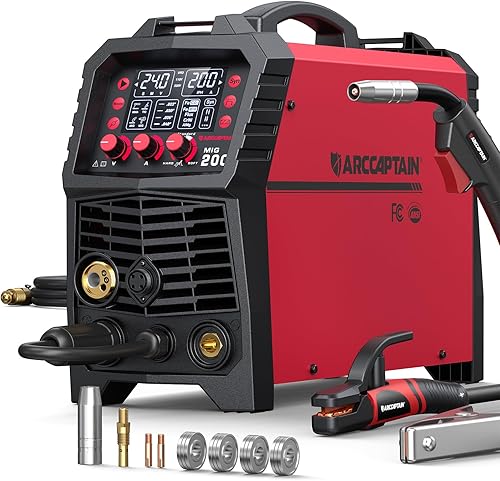 Best for multiple welding modes
ARCCAPTAIN 200A MIG Welder 110V 220V
9.7/10 our score
See it on Amazon -
3

- 4
 Best for dual-voltage manual controlCheck it
- 5
 Best for light, gasless jobsCheck it
- 6
 Check it
Lincoln Electric 90i FC Flux Core Wire
Best for portable 120V flux-core work - 7
 Best for compact flux-core and stick workCheck it
- 8
 Check it
ARCCAPTAIN 165A MIG Welder 110V 220V 4-in-1
Best for a light four-mode machine - 9
 Check it
ARCCAPTAIN 160A MIG Welder 110V 220V Gasless
Best for compact dual-voltage repairs
How we chose these 110V/220V wire feed welders
We compared input voltage, wire-feed processes, controls, portability and included accessories against the needs of buyers seeking household and shop power flexibility. We also included several 110V or 120V-only alternatives for readers whose work stays near a standard outlet.
The best fit depends on your power supply and welding process. A dual-voltage machine offers more input options, while a single-voltage flux-core welder may be enough for small repairs.
Our score weighs specs, features and buyer feedback against what you're shopping for.
| Product | Best for | Input | Output | Wire | Our score |
|---|---|---|---|---|---|
| FORNEY Easy Weld 140 Amp 120-Volt Flux-Cored | simple household flux-core work | 120V | 140A | 0.030 in flux-core | 9.7 |
| ARCCAPTAIN 200A MIG Welder 110V 220V | multiple welding modes | 110V/220V | 9.7 | ||
| PRIMEWELD MIG180 Mig Welder | aluminum and stick options | 120V/240V | 9.6 | ||
| YESWELDER 160A MIG Welder | dual-voltage manual control | 110V/220V | 160A | 9.6 | |
| YESWELDER 135A MIG Welder | light, gasless jobs | 110V | 135A | 9.5 | |
| Lincoln Electric 90i FC Flux Core Wire | portable 120V flux-core work | 120V | 9.5 | ||
| FEMEROL MIG Welder | compact flux-core and stick work | 110V | 130A | 9.4 | |
| ARCCAPTAIN 165A MIG Welder 110V 220V 4-in-1 | a light four-mode machine | 110V/220V | Up to 165A | 9.3 | |
| ARCCAPTAIN 160A MIG Welder 110V 220V Gasless | compact dual-voltage repairs | 110V/220V | 160A | 8.4 |
The best dual voltage wire feed welders
The picks below are ordered by score, with 110V/220V models and single-voltage alternatives clearly distinguished. Check each machine's input and process before deciding that it fits your outlet and work.
FORNEY Easy Weld 140 Amp 120-Volt Flux-Cored: Best for simple household flux-core work
- 120V input
- 140A output
- Flux-core wire feed
- Infinite voltage and wire-feed controls
A portable flux-core choice for buyers who have household power and don't need dual-voltage input. It uses 0.030 in flux-core wire and needs at least a 20A breaker.
Pros
- No shielding gas needed
- 19 lb weight
- Infinite voltage and wire-feed controls
Cons
- 120V input only
- Requires at least a 20A breaker
The FORNEY Easy Weld 140 is a 120V-only flux-core welder, so it's not a dual-voltage pick. It earns the top spot for buyers who want a straightforward wire-feed machine for a compatible household circuit and don't need a 220V shop connection.
It uses 0.030 in flux-core wire and has infinite voltage and wire-feed speed controls. Forney states that it can weld mild steel up to 1/4 in and run without gas.
The machine weighs 19 lb and accepts 2 lb and 10 lb wire rolls.
Forney includes an 8 ft MIG gun, an 8 ft ground clamp and a 20A-to-15A adapter. The manufacturer says the welder can run from standard household power with at least a 20A breaker.
Check your circuit and outlet before use.
Choose it for household-power flux-core jobs where portability and simple controls matter. If you need a machine that accepts both household and shop voltage, choose one of the dual-voltage options below.
ARCCAPTAIN 200A MIG Welder 110V 220V: Best for multiple welding modes
- 110V/220V input
- Six welding modes
- Synergic MIG controls
- Stores 10 parameter groups per mode
A dual-voltage option with several welding modes and stored settings. It suits buyers who want one machine for different jobs and can follow its power-switching instructions.
Pros
- Six welding modes
- Synergic and manual controls
- Shoulder strap included
Cons
- TIG and spool guns are not included
- Some wire rollers need to be bought separately
The ARCCAPTAIN MIG200 is the most versatile pick here for buyers who want dual-voltage input with several welding processes. It supports 110V/220V input and six modes, including gas and gasless MIG, stick, spot welding and lift TIG.
Its synergic controls recommend current and wire-feed speed after you select wire diameter and gas material. You can adjust current manually, and save up to 10 parameter groups for each welding mode.
A large LED display shows settings, while a carrying handle and shoulder strap support transport.
TIG and spool guns are not included. The maker says the spool gun connector is optional, and some wire rollers must be bought separately.
Before changing between 110V and 220V, wait until the screen is off, as the manufacturer instructs.
Pick it when process flexibility and saved settings matter. If your work only calls for flux-core wire, a simpler machine may be easier to set up.
PRIMEWELD MIG180 Mig Welder: Best for aluminum and stick options
- 120V/240V input
- MIG, flux-core and stick processes
- Spool gun included
- 2T/4T trigger lock
A dual-voltage wire-feed machine that adds stick welding and aluminum MIG capability with its included spool gun. The stated input is 120V/240V.
Pros
- Spool gun included
- Can run flux-core without gas
- 2T/4T trigger lock
Cons
- 55 lb weight
- Heavier to move than the compact picks
The PRIMEWELD MIG180 fits buyers who want 120V/240V input and an included spool gun for aluminum MIG wire. It supports MIG, flux-core and stick welding, letting you switch processes based on the job.
The maker describes the spool gun as a way to reduce kinks and jams when feeding soft aluminum wire. It also includes MIG and flux drive rollers and takes standard Tweco consumables.
A 2T/4T trigger lock can help reduce hand fatigue during longer welds.
At 55 lb, this is the heaviest pick in this roundup. Plan where it will sit in your shop before buying, especially if you expect to move the machine often.
Choose it if aluminum work and stick welding are priorities. For a lighter dual-voltage setup, compare the YESWELDER 160A or either ARCCAPTAIN 110V/220V model.
YESWELDER 160A MIG Welder: Best for dual-voltage manual control
- 110V/220V input
- Flux-core MIG, gas MIG, stick and lift TIG
- Synergic and manual controls
- 19.4 lb weight
This 4-in-1 machine combines dual-voltage input with both synergic and manual settings. It accepts 2 lb and 10 lb spools of the stated solid-core or flux-core wire sizes.
Pros
- Four welding processes
- Manual voltage and wire-feed adjustment
- Carrying handle
Cons
- Lift TIG torch sold separately
- Some wire rollers need to be bought separately
The YESWELDER 160A combines 110V/220V input with four processes: flux-core MIG, gas MIG, stick and lift TIG. It has both synergic control, which recommends voltage and wire speed, and manual control for adjusting those settings yourself.
The machine accepts 2 lb and 10 lb spools of 0.030 in and 0.035 in solid-core or flux-core wire. Its stated weight is 19.4 lb, and it has a carrying handle.
A lift TIG torch is required separately.
That mix of manual settings, process options and spool sizes makes it useful for buyers whose work may change over time. Confirm that the voltage, wire and accessories match your intended setup.
Choose it if you want to move between preset guidance and manual adjustment. Forney wire options are covered in our guide to Forney welding wire.
YESWELDER 135A MIG Welder: Best for light, gasless jobs
- 110V input
- Flux-core MIG, stick and lift TIG
- 11.4 lb stated weight
- Synergic control
A compact 110V flux-core choice with stick and lift TIG modes. It isn't dual voltage, but may suit buyers who don't need 220V shop power.
Pros
- Flux-core wire included
- Compact, portable design
- Synergic control with voltage micro-adjustment
Cons
- 110V input only
- Lift TIG torch required separately
The YESWELDER 135A is a 110V-only machine for buyers who want gasless flux-core welding, stick and lift TIG in a portable unit. Its stated weight is 11.4 lb, and the machine includes E71T-GS flux-core wire in 0.030 in and 0.035 in sizes.
The synergic control matches recommended voltage to wire-feed speed, while a small voltage adjustment lets you fine-tune the arc. YESWELDER says the 135A machine can weld mild steel up to 3/32 in thick.
A separate lift TIG torch is required for that process.
It is not a substitute for a dual-voltage machine, so skip it if you need 220V input. For outdoor or windy work, gasless flux-core can avoid the need for a shielding-gas cylinder.
Choose it for light 110V flux-core tasks and portability. Compare its single-voltage setup with the Lincoln if you prefer a simple two-knob machine.
Lincoln Electric 90i FC Flux Core Wire: Best for portable 120V flux-core work
- 120V input
- Flux-core welding
- 15 lb weight
- Two-knob controls
A portable flux-core machine for small jobs where 120V power is available. Its inverter design and two control knobs keep the setup focused on wire speed and voltage.
Pros
- Shoulder strap included
- Protective metal case
- Welding gun and work clamp included
Cons
- 120V input only
- Flux-core process only
The Lincoln Electric Weld-Pak 90i FC is another 120V-only flux-core option. It suits small jobs where portability and a simple control layout matter more than dual-voltage flexibility.
The machine weighs 15 lb and comes with a shoulder strap, protective metal case, welding gun, nozzle, contact tip, work cable and clamp. Two knobs control wire speed and voltage.
Lincoln says the inverter power source provides smoother weld characteristics than traditional welders.
The manufacturer says it can weld up to 1/4 in and can connect anywhere 120V input power is available. Check the manual for the appropriate setup for your work and power supply.
Choose it for portable flux-core welding from a 120V outlet. If your shop has a higher-voltage supply, the dual-voltage picks offer more flexibility.
FEMEROL MIG Welder: Best for compact flux-core and stick work
- 110V input
- Flux-core MIG and MMA
- 9 lb stated weight
- Synergic and manual MIG controls
A small 110V machine with gasless flux-core and stick modes. Its light weight and included starter items suit occasional repairs where dual voltage isn't required.
Pros
- 9 lb stated weight
- Flux-core wire and accessories included
- Manual MIG adjustment available
Cons
- 110V input only
- Two welding modes
The FEMEROL MIG Welder is a compact 110V machine with flux-core MIG and MMA stick modes. At a stated 9 lb, it may suit occasional home repairs or farm work where easy carrying is a priority.
Its synergic setting matches recommended voltage and wire-feed speed to the selected wire diameter. Experienced users can switch to manual MIG adjustment.
The package includes a MIG torch, electrode holder, ground clamp, flux-core wire, gloves, mask, brush and contact tips and nozzles.
The 130A machine is not dual voltage, so check your power needs before choosing it. Its two processes cover common gasless wire-feed and stick work, but don't provide the broader process range of the 4-in-1 picks.
Choose it for a light 110V setup with starter accessories. If you need a machine for 220V shop power too, look at the dual-voltage models above.
ARCCAPTAIN 165A MIG Welder 110V 220V 4-in-1: Best for a light four-mode machine
- 110V/220V input
- Gas MIG, flux-core MIG, lift TIG and MMA
- 12.8 lb stated weight
- 2 lb spool capacity
This compact dual-voltage welder offers four processes and includes several basic accessories. It holds a 2 lb spool only, so check spool size against your work plan.
Pros
- Four welding modes
- 110V/220V input
- Torch, ground clamp and wire included
Cons
- 2 lb spool capacity only
- Lift TIG torch sold separately
The ARCCAPTAIN 165A offers 110V/220V input in a 4-in-1 package with gas MIG, flux-core MIG, lift TIG and MMA. Its stated weight is 12.8 lb, which makes it one of the lighter dual-voltage choices here.
It includes a MIG torch, ground clamp, electrode holder, rollers and 2 lb flux-core wire. The machine holds a 2 lb spool only.
The manufacturer says to switch voltage only after the screen is off and the fan has stopped.
The maker states a 60% duty cycle and says the machine can handle mild steel up to 3/16 in. Lift TIG requires a separate WP-17V torch.
Keep those requirements in mind if you plan to use more than MIG or flux-core.
Choose it if you want four processes in a lightweight machine. Its spool limit makes it a better match for smaller wire rolls than for buyers who need larger spools.
ARCCAPTAIN 160A MIG Welder 110V 220V Gasless: Best for compact dual-voltage repairs
- 110V/220V input
- Gas and gasless MIG, lift TIG and MMA
- 11.8 lb weight
- Synergic control
A compact 4-in-1 option for home repairs and outdoor work, with dual-voltage input and synergic wire-feed settings. A lift TIG torch is an extra purchase.
Pros
- Four welding modes
- 11.8 lb weight
- Synergic wire-feed settings
Cons
- Lift TIG torch sold separately
- Follow the power-off instructions before changing voltage
The ARCCAPTAIN 160A is a compact 110V/220V machine with gas MIG, gasless flux-core MIG, lift TIG and MMA modes. It weighs 11.8 lb and has synergic controls that recommend current and wire-feed speed based on wire diameter.
The machine supports .030 in, .035 in and .040 in wire according to its feature details. A lift TIG torch is an extra purchase.
The manufacturer warns users not to power the machine on again until its screen turns off and fan stops.
This model is a reasonable fit for home repairs, outdoor work and maintenance when you need dual-voltage input and don't need a more detailed feature set. Confirm the input and process setup for the job before connecting it.
Choose it for compact dual-voltage repairs. If you need saved presets or a wider set of controls, compare it with the ARCCAPTAIN MIG200.
How should you choose a 110V/220V wire feed welder?
Start with the outlet you can use and the machine's stated input range. A 110V-only welder cannot be treated as a 110V/220V model, while a dual-voltage machine still needs the right outlet and setup for each input.
Voltage is one part of the decision. Read our guide to voltage in welding for a plain explanation of how it relates to the arc and machine settings.
Next, match the process to your work. Flux-core wire can be useful without shielding gas, while gas MIG needs the correct gas setup.
Some models here also support stick, lift TIG or aluminum wire with a spool gun.
Portability and accessories matter, too. Compare stated weight, spool size, included torch and clamps, and whether you need to buy a separate TIG torch or wire roller.
A machine that supports more processes may still require add-ons before you can use them.
Is a dual-voltage MIG welder right for home and shop use?
A dual-voltage MIG welder can be a good fit if your work moves between compatible household and shop outlets. Choose a model that explicitly supports both inputs, such as the MIG200, MIG180, YESWELDER 160A or ARCCAPTAIN 165A and 160A.
Don't infer input compatibility from the welder's output amp rating or its process count. Check the model's marked input and manual, then make sure the circuit and connection are suitable.
If you're comparing broader process choices, see our best dual voltage MIG welder guide.
When should you choose gas MIG or flux-core wire?
Choose flux-core if you want a wire-feed process that can run without shielding gas on a compatible machine. Gas MIG may fit work where you want to use solid wire with shielding gas, provided your welder supports it and you have the gas setup.
Some picks in this guide support both gas and gasless MIG. For models and process details focused on shielding gas, see our best gas shielded MIG welders.
Which dual voltage wire feed welder should you pick?
Choose the ARCCAPTAIN MIG200 if you want 110V/220V input, six welding modes and saved parameter groups. Pick the PRIMEWELD MIG180 if aluminum work with an included spool gun is a priority, or the YESWELDER 160A if you want both synergic and manual wire-feed control.
For simple flux-core use near a compatible household outlet, the FORNEY Easy Weld 140 is the clear choice, but it accepts 120V only. Match the machine to your available power, intended process and wire before you buy.
Our top 3 picks at a glance
-
1
Best for simple household flux-core work
FORNEY Easy Weld 140 Amp 120-Volt Flux-Cored
9.7/10 our score
See it on Amazon -
2
Best for multiple welding modes
ARCCAPTAIN 200A MIG Welder 110V 220V
9.7/10 our score
See it on Amazon -
3
Frequently asked questions
Can a wire feed welder run on both 110V and 220V?
Yes, if the machine is built for dual-voltage input. Models here include 110V/220V or 120V/240V options, while other wire-feed welders are 120V or 110V only.
Check the machine's input labels and the outlet before connecting it.
What is the benefit of a 110V/220V wire feed welder?
A dual-voltage welder can connect to compatible household or higher-voltage shop power, which gives you more placement options. The exact input depends on the model, so confirm the voltage and outlet match before use.
Input voltage alone doesn't tell you what material thickness a machine can weld.
Can a 110V welder use 220V power?
Only if the welder is designed for that input voltage. A 110V-only machine should not be connected to 220V power.
Check the machine's label and manual, and use the correct outlet and cable setup for its stated input.
Do wire feed welders need gas?
Flux-core wire can be used without shielding gas on machines set up for gasless flux-core welding. Solid-wire MIG uses shielding gas, and some machines support both processes.
Choose the process and wire that match the machine and the work conditions.
Can you switch a dual-voltage welder while it is on?
Follow the machine's instructions and turn it off before changing input voltage. ARCCAPTAIN cautions users to wait for the screen to turn off, and one model also says to wait for the fan to stop.
Check the manual for the exact model before switching.