Best 110V TIG Welders: Top 9 Picks (November 2026)
The best 110V TIG welders include the S7 200A TIG Welder for TIG-first home projects, the YESWELDER 205A MIG Welder for five-process flexibility, and the BILT HARD 135A 3-in-1 IGBT Inverter Welder for simple 110V multiprocess use.
On this page (5 sections)
A 110V TIG welder can suit lighter garage repairs and home projects when its process, output and torch setup match the work. For more home-shop options, see TIG welders for home use.
The S7 is the most direct TIG choice here; the remaining picks are multiprocess machines with Lift TIG among their modes.
A household outlet is convenient, but it doesn't make every machine equally suited to every project. Compare the process type first, then check input options and the items included for TIG work.
For a plain-language overview, see What Is a TIG Welder? A Practical Answer.
Our picks at a glance
-
1

-
2

-
3
 Best for simple 110V multiprocess use
BILT HARD 135A 3-in-1 IGBT Inverter Welder
9.6/10 our score
See it on Amazon
- 4
 Best for portable 110V repairsCheck it
- 5
 Check it
ARCCAPTAIN 165A MIG Welder 110V 220V 4-in-1
Best for dual-voltage repair work - 6
 Check it
ANDELI 110V/220V PULSE Flux Core MIG Welder
Best for pulse Flux Core and TIG - 7
 Check it
TOOLIOM 135A 110V Stick Welder Kit
Best for Stick with included Lift TIG - 8
 Best for lightweight 110V MIGCheck it
- 9
 Check it
ARCCAPTAIN 160A MIG Welder 110V 220V Gasless
Best for portable dual-voltage MIG
The best 110V TIG welders for home projects
The S7 is the clear TIG-first pick, while the other machines make more sense if MIG or Stick work is part of the same job list. We compared process options, voltage support, output details and whether the TIG torch is included.
S7 200A TIG Welder: Best for TIG-first home projects
- DC TIG and Stick
- 110V/220V dual voltage
- Up to 200A
- Digital current display
This is the most direct match for a buyer who wants a TIG machine for a home garage. It combines DC TIG and Stick welding and supports both 110V and 220V input.
Pros
- TIG is a primary process
- Supports household and 220V input
- TIG torch and common consumables are included
Cons
- DC TIG only
- Output and material capacity depend on input and setup
The S7 is the strongest match if TIG is your main reason for buying a welder. It combines DC TIG and Stick in one inverter machine and supports 110V or 220V input.
Compare more inverter TIG welders if you want other machine options.
The digital current display and simple controls are aimed at DIY users and hobbyists. Its package includes a TIG torch, ground clamp and electrode holder, plus compatibility with common tungsten electrodes, ceramic cups and collets.
This is a DC TIG machine, so don't assume it has the AC TIG mode commonly sought for aluminum work. If you need AC/DC TIG output, compare AC/DC TIG welders under $1000.
The stated output reaches 200A, but actual performance depends on input voltage and conditions.
Choose it for garage repair, stainless steel or mild steel projects where TIG control matters. If DC-only machines fit your plans, compare it with our guide to the best DC TIG welder.
YESWELDER 205A MIG Welder: Best for five-process flexibility
- 110V/220V dual voltage
- Gas MIG, Flux Core MIG, spool gun MIG, Lift TIG and Stick
- Up to 200A
- Synergic and manual MIG settings
A broad process mix makes this a fit when MIG or Stick work matters as much as occasional Lift TIG. A Lift TIG torch and spool gun are additional purchases.
Pros
- Five welding modes
- Dual voltage
- Synergic and manual MIG control
Cons
- Lift TIG torch is not included
- More focused on MIG than TIG
The YESWELDER 205A is a multiprocess machine for buyers who want MIG to lead and Lift TIG as an additional option. It supports gas MIG, Flux Core MIG, spool gun MIG, Lift TIG and Stick, with both 110V and 220V input.
Its synergic MIG mode pairs wire speed with a recommended voltage, while manual controls let you set them yourself. Those features are relevant to MIG setup, but the machine is not a TIG-first model.
A Lift TIG torch and spool gun are required separately for those modes. Confirm the extra equipment and process setup before treating it as ready for TIG work.
Pick it when the breadth of MIG modes matters alongside occasional Lift TIG. Buyers who want to compare by brand can also read about the best Miller TIG welder.
BILT HARD 135A 3-in-1 IGBT Inverter Welder: Best for simple 110V multiprocess use
- 110V input
- Flux Core MIG, Lift TIG and Stick
- Synergic control
- LED display
This 110V-only option combines Flux Core MIG, Lift TIG and Stick with synergic control. The Lift TIG torch is not included, so account for that before choosing it for TIG work.
Pros
- Designed for standard 110V input
- Three process options
- Synergic control adjusts MIG settings
Cons
- Lift TIG torch not included
- 135A output
The BILT HARD fits buyers who need a 110V-only multiprocess welder for home projects. Its modes are Flux Core MIG, Lift TIG and Stick, and synergic control adjusts MIG voltage and wire feed based on selected amperage.
For TIG, plan for a separate torch because one isn't included. The machine also offers an LED display and trigger modes for different welding runs.
The maker describes the inverter as designed for standard 110V outlets. Output is rated up to 135A, so compare that figure and the machine's operating guidance with your material and duty needs.
Choose it if MIG and Stick flexibility are useful and TIG is a secondary process. If you're new to the process, our guide to the best TIG welder for beginners can help you compare beginner-oriented options.
YESWELDER 135A MIG Welder: Best for portable 110V repairs
- 110V input
- Flux Core MIG, Lift TIG and Stick
- 135A output
- Lift TIG torch sold separately
This compact multiprocess machine can suit small repair jobs where Flux Core MIG is the main process and Lift TIG is occasional. It weighs 11.4 lb and requires a separate Lift TIG torch.
Pros
- Three process modes
- 110V household input
- Portable design
Cons
- Lift TIG torch sold separately
- MIG-centered rather than TIG-first
The YESWELDER 135A is a portable 110V option for buyers whose main work is Flux Core MIG. It also supports Stick and Lift TIG, with the TIG torch sold separately.
At 11.4 lb, it is easier to carry between a garage and an outdoor repair area than heavier machines. Its synergic settings match a recommended voltage to wire speed, with a small voltage adjustment range for manual fine tuning.
The brand says it can handle mild steel up to 3/32 in. That is a useful boundary for planning light work, but the torch requirement still matters if TIG is the main goal.
Choose it for compact MIG-centered repairs where 110V input is needed. Look elsewhere if you want a TIG torch in the box or a dedicated TIG machine.
ARCCAPTAIN 165A MIG Welder 110V 220V 4-in-1: Best for dual-voltage repair work
- 110V/220V dual voltage
- Gas MIG, Flux Core MIG, Lift TIG and Stick
- Up to 165A
- 60% rated duty cycle
Its dual-voltage input gives you the option to use household power or switch to 220V where available. The machine is primarily a MIG welder, and its Lift TIG torch must be bought separately.
Pros
- Dual-voltage input
- Four process modes
- MIG settings include synergic and manual control
Cons
- Lift TIG torch not included
- MIG165 accepts only a 2 lb wire spool
The ARCCAPTAIN 165A offers 110V/220V input with Gas MIG, Flux Core MIG, Lift TIG and Stick modes. That makes it a flexible repair machine when the work includes more than TIG.
Its controls include synergic MIG settings and manual adjustments. The maker states a 60% rated duty cycle, and the unit weighs about 12.8 lb according to its product information.
The Lift TIG torch must be purchased separately. Also note that the MIG165 accepts a 2 lb wire spool only, which can matter if you expect to run larger spools during MIG work.
Pick it when dual voltage and multiple processes are priorities. For mostly TIG welding, the S7 is a more direct match.
ANDELI 110V/220V PULSE Flux Core MIG Welder: Best for pulse Flux Core and TIG
- 110V/220V dual voltage
- Pulse Flux Core MIG, Gasless MIG, Lift TIG and Stick
- 135A
- Lift TIG torch sold separately
This 135A machine pairs pulse Flux Core MIG with Lift TIG and Stick. Its dual-voltage design gives it more input flexibility than a 110V-only welder, but the TIG torch is sold separately.
Pros
- Pulse Flux Core MIG mode
- Dual-voltage input
- Four process options
Cons
- Lift TIG torch sold separately
- More MIG-focused than TIG-focused
ANDELI combines pulse Flux Core MIG, Gasless MIG, Lift TIG and Stick in a dual-voltage machine. It is a sensible option when the pulse MIG feature matters and TIG is one of several planned processes.
The 4.1 in LED display shows real-time data, and the machine supports .030, .035 and .040 in flux-core wire. Its package includes several welding accessories, but the Lift TIG torch is sold separately.
ANDELI describes it as beginner friendly, with synergic control that adjusts parameters from current settings. That guidance applies to setup, while safe use still depends on learning the process and following the manual.
Choose it for mixed MIG and Stick work where Lift TIG is useful as an extra. If TIG is your daily process, focus on a TIG-first machine instead.
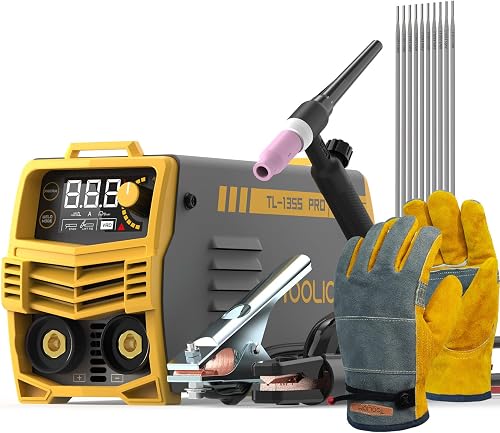
TOOLIOM 135A 110V Stick Welder Kit: Best for Stick with included Lift TIG
- 110V household input
- Stick and Lift TIG
- Lift TIG torch included
- VRD, Hot Start and ARC Force
This kit suits a buyer who wants to alternate between Stick and Lift TIG without adding MIG. It includes a Lift TIG torch, rods and gloves.
Pros
- Lift TIG torch included
- Stick and Lift TIG modes
- Household 110V input
Cons
- Stick-focused machine
- No MIG process
The TOOLIOM 135A is a Stick and Lift TIG machine for buyers who don't need MIG. It runs from standard 110V household current and includes a Lift TIG torch, welding rods and gloves.
VRD, Hot Start and ARC Force are listed among its functions. The LCD display shows welding data, and an adjustable shoulder strap helps carry it between work areas.
This kit has a narrower process range than the multiprocess MIG options. That can be a benefit if Stick and Lift TIG cover your needs, but it won't serve as a MIG machine.
Choose it when included TIG equipment and Stick capability are more useful than MIG flexibility. Confirm the torch setup and consumables required for your specific work.
Futelo 145A MIG Welder: Best for lightweight 110V MIG
- 110V input
- Flux Core MIG, Stick and Lift TIG
- 145A output
- 7.5 lb
At 7.5 lb, this is the lightest option in this group. It combines Flux Core MIG, Stick and Lift TIG, though a separate TIG torch is needed.
Pros
- Very light at 7.5 lb
- Three process modes
- Synergic control for MIG
Cons
- TIG torch not included
- MIG-focused
The Futelo is the lightest pick here at 7.5 lb, with 110V input and Flux Core MIG, Stick and Lift TIG modes. Its output range is 30–145A.
The synergic control can adjust voltage and wire speed based on selected wire diameter or amperage. It also suggests metal thickness, while the LED display shows current and wire diameter.
A Lift TIG torch is not included, so the low weight doesn't make it a ready-to-use TIG kit by itself. The supplied accessories include a MIG torch, ground clamp, electrode holder, rods, wire, goggles and gloves.
Choose it when portability and MIG matter most, with TIG as an occasional additional process. For regular TIG work, prioritize torch inclusion and process details over weight alone.
ARCCAPTAIN 160A MIG Welder 110V 220V Gasless: Best for portable dual-voltage MIG
- 110V/220V dual voltage
- Gas and Flux Core MIG, Lift TIG and Stick
- 160A
- Synergic MIG control
This 11.8 lb machine is a portable choice for buyers who want MIG options and occasional Lift TIG. The torch for Lift TIG is an extra purchase.
Pros
- Dual-voltage input
- Four process modes
- Synergic MIG settings
Cons
- Lift TIG torch sold separately
- TIG is an added mode on a MIG machine
The ARCCAPTAIN 160A combines Gas MIG, Flux Core MIG, Lift TIG and Stick with 110V/220V input. At 11.8 lb, it is a portable option for mixed repairs.
Its synergic control matches recommended current and wire feed speed to the selected wire diameter. It supports .030, .035 and .040 in wire, and includes protections for over-current, overload, overheating and over-voltage.
The Lift TIG torch is an extra purchase, and the machine's process list doesn't make it a dedicated TIG model. Check the voltage switching instructions and turn the unit off as directed before changing input.
Choose it for portable MIG-centered work where Lift TIG is useful occasionally. If you need TIG as the primary process, compare it with the S7 first.
How to choose a 110V TIG welder
The best 110V TIG welder depends on whether TIG is your main process or one mode in a multiprocess machine. Start with process type and torch inclusion, then match input and output to the work.
A TIG-first machine like the S7 has DC TIG and includes a torch. Multiprocess MIG machines add flexibility, but most here require a separate Lift TIG torch, so budget for the extra equipment and confirm what else the torch setup needs.
Think about metal type as well. These picks identify DC TIG or Lift TIG, and none of the supplied product details establishes AC TIG capability; if aluminum TIG is the goal, confirm the exact machine process before buying.
Is household 110V enough for TIG welding?
A 110V supply can work for lighter home and garage tasks, but it doesn't guarantee a particular output on every machine. Materials, joint design, settings, circuit capacity and duty cycle affect what a welder can handle.
Some picks support both 110V and 220V, while the BILT HARD, YESWELDER 135A, TOOLIOM and Futelo specify 110V input. Check the manual for the circuit requirements and the output available at the voltage you plan to use.
For more background on matching output to your project, read What Size Welder Do I Need? What to Know.
Should you choose Lift TIG or high-frequency TIG?
Lift TIG may suit you if the machine's other processes are useful and you are comfortable with its contact-start method. High-frequency start avoids touching the tungsten to the work, so compare start method and machine specifications before choosing.
This roundup includes Lift TIG on the multiprocess machines, while the S7 is described as DC TIG. The process name alone doesn't confirm high-frequency start, so check the exact model requirements and included torch.
See our best high frequency TIG welder guide for machines selected around that start method. You can also compare the best lift TIG welder options if Lift TIG fits your setup.
Our 110V TIG welder verdict
Choose the S7 if you want a TIG-first machine with a torch included and support for 110V or 220V input. Pick a multiprocess welder if MIG or Stick will do more of your work, and verify whether its Lift TIG torch is an extra purchase.
For lighter household work, confirm the circuit, the material thickness guidance and the process before ordering. A 110V label is only one part of choosing the right welder.
Our top 3 picks at a glance
-
1
-
2
-
3
Best for simple 110V multiprocess use
BILT HARD 135A 3-in-1 IGBT Inverter Welder
9.6/10 our score
See it on Amazon
Frequently asked questions
Can a 110V TIG welder run from a household outlet?
Some TIG welders are designed for 110V input, but the outlet and circuit still need to match the machine's requirements. Check the welder manual and circuit capacity before connecting it.
A dual-voltage machine can also support 220V, but switch input only as its instructions allow.
Is 110V enough for TIG welding?
110V can suit lighter home and garage TIG work, though available output may be limited compared with a compatible 220V supply. Material thickness, electrode, joint type and the machine's duty cycle all affect what you can weld.
Check the maker's output guidance for your setup.
What is the difference between Lift TIG and high-frequency TIG?
Lift TIG starts the arc by touching the tungsten to the work and lifting it, while high-frequency TIG starts without that contact. The machines in this roundup list Lift TIG where offered; check the process details before assuming high-frequency start is available.
See our guide to high frequency TIG welders.
Does a 110V TIG welder weld aluminum?
These picks are DC TIG or Lift TIG machines, and the supplied product details do not identify AC TIG for aluminum. Check the process type before choosing a machine for aluminum, since a TIG label alone does not confirm the current type or aluminum capability.
What else should I check before buying a 110V welder?
Confirm the welding process, input voltage, required circuit, torch inclusion and consumables. Then match the machine to your material and project size.
Our guide to welder size and output explains how workload and material affect your choice.


